

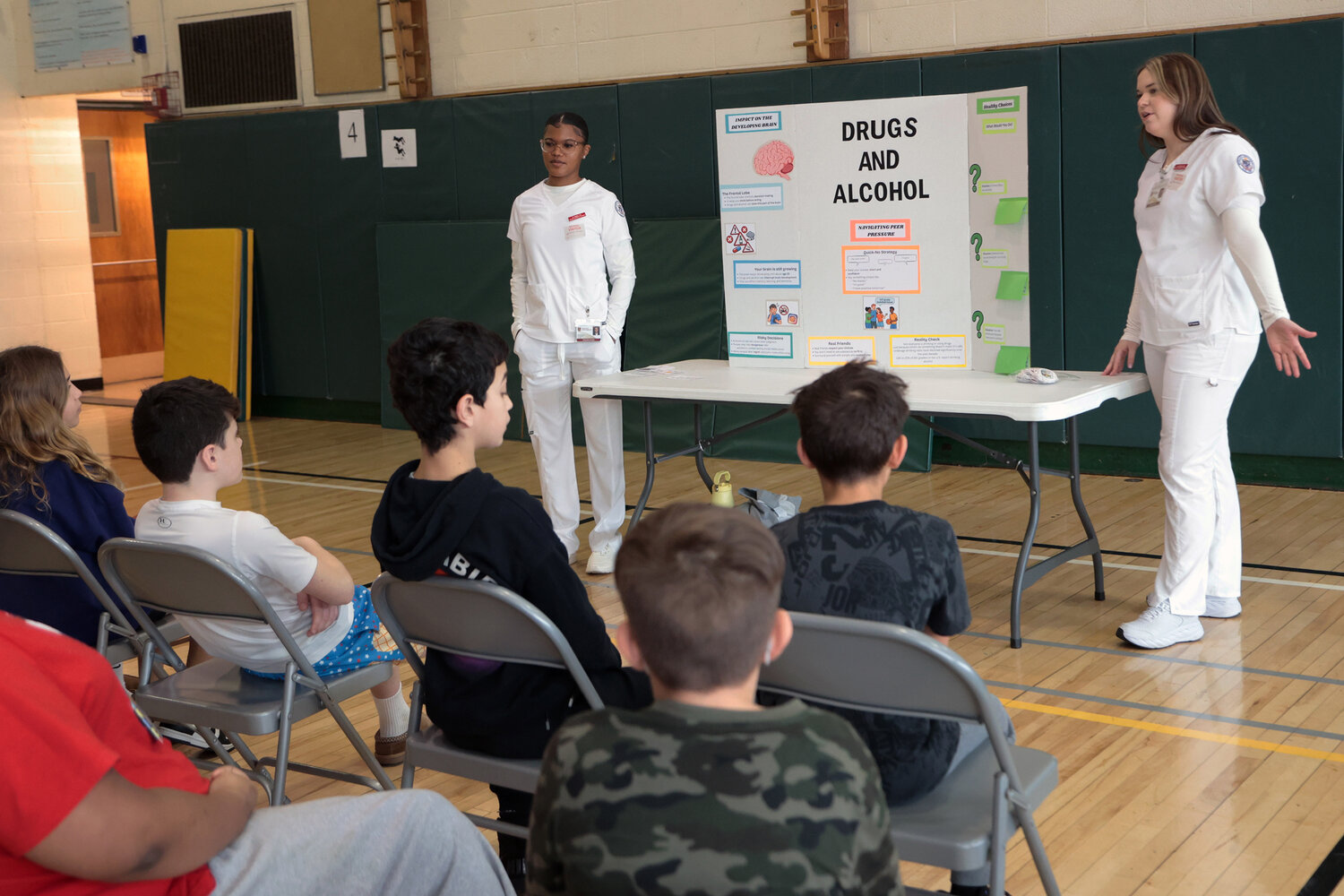


Moving in and out of classrooms like doctors on rotation, Lynbrook North Middle School sixth-graders learned about vaping, stress, cyberbullying and other health topics during a health expo led by Molloy University nursing students.
The event, on March 11 at the middle school, divided students in groups of about 15 and rotated them through 10-minute presentations for nearly 90 minutes. The sessions were designed to introduce middle-schoolers to real-world health issues, and to the idea of making healthy decisions as they grow older.
North Middle School health teacher Brian Bowes, who helped organize the event, said that students from Molloy’s nursing program have been visiting the school for the past six years.
“The idea of the health fair today is to expand your knowledge of a number of different health topics that some of you taking health this year might know already,” Bowes told the sixth-graders. “Impress the students of Molloy Nursing and learn more about each topic.”
In one presentation, Molloy students Lielle Aranbayev and Salvatore Bacarella discussed smoking and vaping, asking students how they would respond if a friend offered them a vape.
“No!” the class replied in unison.
The pair ex-plained how nicotine can affect the body, including raising blood pressure and damaging the lungs. Bacarella also pointed out that vaping and smoking can impact athletic performance. “If you’re an athlete, it makes working out and moving your body much harder,” he said.
Students were also encouraged to share what they learned with family members who smoke. Several responded that smoking is addictive and can lead to serious health problems such as cancer.
Another session focused on drugs and alcohol. Nursing students Mikayla Berry and Kara Colgan explained that the brain’s frontal lobe — which is responsible for decision-making and impulse control — does not fully develop until around age 26. Because of that, they emphasized the importance of refusing drugs and alcohol and protecting brain health during adolescence.
Students practiced ways to decline offers assertively, and discussed how early decisions can influence their future health and opportunities.
Stress and anxiety were the focus of a presentation led by Molloy students Jessica Mauro and Isabel Interiano Jordan. Asked what situations caused them stress, many students said tests and schoolwork.
Mauro explained that not all stress is harmful. “A little bit of stress before a test can motivate you to study and prepare,” she said, noting that the feeling can encourage responsibility and better performance.
The presenters also shared strategies to manage stress, including breathing exercises and other techniques to calm the body.
Another topic was cyberbullying, and nursing students Madison Leonard and Marshele Juste asked students if they had ever encountered bullying online.
One student shared a personal experience. “Someone sent a picture of me to a group chat with a few kids in the class, and I did not give them permission to share it,” she said.
Several classmates reacted immediately, saying they would feel upset or embarrassed if something like that happened to them. Others nodded in agreement.
The discussion then turned toward the importance of consent and respect when sharing images or information online. Students agreed that cyberbullying is wrong, and said they would turn to a trusted adult if they ever experienced or witnessed something similar.
The final presentations focused on personal hygiene and sleep habits, led by Molloy students Melanie McIntyre and Jake Marino. Students reviewed proper tooth-brushing techniques and discussed how nighttime routines affect sleep quality.
McIntyre explained that electronic devices should be avoided for about an hour before bedtime because the light from screens interferes with the body’s production of melatonin, a hormone that helps regulate sleep. Students also learned that eating immediately before bed can cause indigestion and disrupt sleep.
One middle-schooler shared a relatable experience during the discussion.
“I don’t know what restaurants put in their food, but I get really sleepy after eating out with my family,” she said.
McIntyre explained that feeling tired after eating is common, but students should remain upright for about a half hour before lying down so the body has time to digest food properly, and avoid discomfort during sleep.
At the conclusion of the event, students gathered in the gym and were encouraged to apply what they had learned to their daily lives. Bowes said the expo gave them the chance to hear important health information from those outside their usual classroom instruction.
“This is a great experience for the students at Lynbrook North Middle School to be able to get health information from a different resource than they’re used to,” he said.
Helen Dubinsky, an assistant professor of nursing at Molloy, said the program is also valuable for the nursing students leading the sessions. “The nursing students learn a lot from the program as well — team building, brainstorming and how to interact with children regarding issues they might face in their future careers as nurses,” Dubinsky explained. “Many of them are interested in pediatrics.”
She added that the event combines education with community engagement. “This event is a merger of the community and education,” Dubinsky said. “Our students take care in choosing how to present each topic to younger audiences, and it’s important for them to learn about this before experiencing it.”


