
Thursday, October 1, 2026



One hundred years ago, the communities hugging the western shore of the Rockaway peninsula were already starting to grow — but they didn’t yet have a shared name. The stockbrokers and garment merchants building summer estates in Hewlett, the Irish and Italian families settling into Inwood and Lawrence, the Jewish families beginning to put down permanent roots in Cedarhurst, the old Protestant aristocracy retreating behind the gates of Back Lawrence — they all shared a peninsula and a railroad line, but hadn’t yet come to think of themselves as a single community.
The name that would bind them came into use gradually and naturally in the early 20th century. The five consecutive stops on the Long Island Rail Road’s Far Rockaway Branch — Hewlett, Woodmere, Cedarhurst, Lawrence, Inwood — gave residents an obvious shorthand for their cluster of communities. By the early 1930s, “the Five Towns” had passed into common usage, and in 1931 the newly formed Five Towns Community Chest became the first organization to make it official in its name.
In the century since, these five communities — along with Woodsburgh, Hewlett Harbor, Hewlett Neck, Hewlett Bay Park, Atlantic Beach, North Woodmere and Meadowmere Park — have lived more history, weathered more heartbreak, and generated more community pride than almost any other patch of suburbia in America.
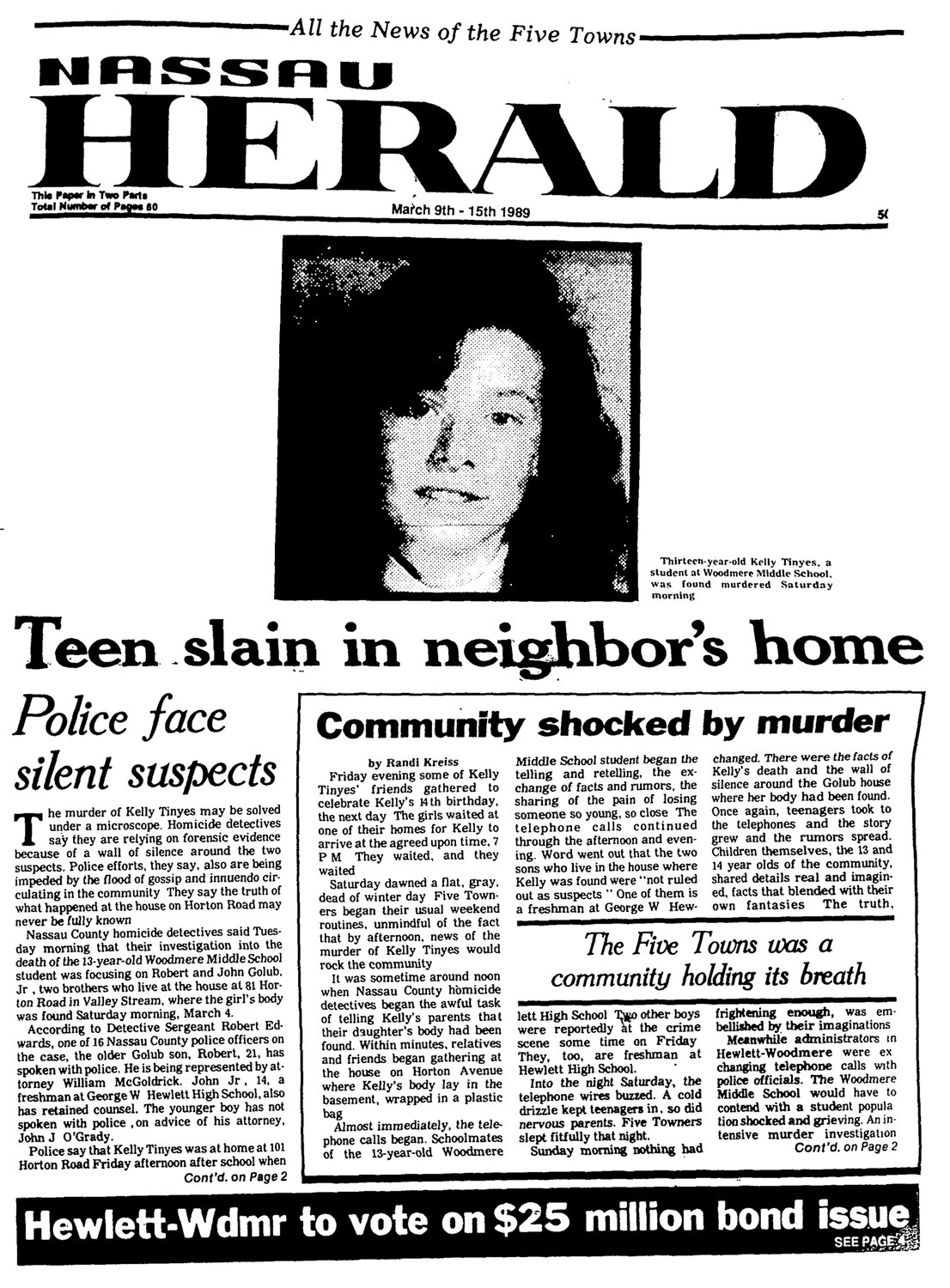
The Nassau Herald was founded by the Beegle brothers as the Rockaway Branch Journal and renamed around 1931 to its current title. In 1964, the husband-and-wife team of Robert and Edith Richner purchased the newspaper and became its publishers. Today, the Richner family continues to lead the publication as owners of the Nassau Herald’s parent company, Richner Communications, which publishes 25 editions of the Long Island Herald.
Ultimately, however, the newspaper belongs to you—the community. For 100 years, the Nassau Herald has served the Five Towns with pride and humility. This is the story of that century, told for the people who lived it, are living it and will carry it forward.
The Roaring Twenties: Estates, parishes and the making of something new
When the 1920s opened, the Five Towns were in transition from the Gilded Age to something faster, louder and more democratic. Developer Carleton Macy’s Hewlett Bay Park Corporation was erecting large homes on five-acre plots — elegant seasonal retreats for New York City’s wealthy. But the real texture of daily life was being stitched together by ordinary families putting down roots.
The three Catholic parishes that would anchor the Irish and Italian communities for generations were already established fixtures of the landscape. Our Lady of Good Counsel (Inwood), St. Joachim’s (Cedarhurst), and St. Joseph’s (Hewlett) served families who had come to the Five Towns to work — on the estates, on the railroad, in the trades — and who stayed to build homes, raise children and create the stable working-class and middle-class backbone of communities that might otherwise have been purely enclaves of the wealthy. The parishes were more than churches. They were schools, social halls, youth organizations, and the connective tissue of neighborhoods that would endure for a century.
The twenties definitely roared in the Five Towns. Arnold Rothstein — widely believed to have bankrolled the fixing of the 1919 World Series and the real-life inspiration for Meyer Wolfsheim in “The Great Gatsby” — operated a beachfront casino at Hewlett Harbor as early as 1916. Prohibition, which arrived in 1920, deepened the area’s underworld connections. The Five Towns’ labyrinth of bays, inlets and channels was tailor-made for rum-running. The respectable and the illicit existed side by side, separated only by the discretion that money buys.
In 1920, Harvey Milk was born in Woodmere — a Jewish kid who would grow up in these streets, play football, love opera, teach at George W. Hewlett High School, and, in 1977, elected to the San Francisco board of supervisors as the first openly gay man elected to public office in the United States. Tragically he and then-Mayor George Moscone were assassinated in 1978. The Five Towns had helped raise someone who would change America.
The 1930s: Depression, the new deal and baseball under the lights
The Depression hit the Five Towns the way it hit every American community — but with particular cruelty in a place where wealth had been concentrated. The great estates of Back Lawrence and Hewlett Bay Park were subdivided and sold off. An era ended quietly and without ceremony.
The federal government’s response left a permanent mark. In 1937, WPA workers constructed the Cedarhurst Municipal Stadium near Peninsula Boulevard and Rockaway Turnpike on the site of the present-day Lawrence High School. Between 1937 and 1941, the stadium hosted the New York Black Yankees and the Brooklyn Royal Giants of the Negro National League — among the finest players in the country. Ironically, the WPA had created a venue for Black athletes of the highest caliber to play in a community that was simultaneously and systematically excluding Black families from buying homes — a contradiction as American as the game being played.
The WPA also produced something more durable than a stadium: a book. Workers from the Federal Writers’ Project compiled “The Story of the Five Towns,” capturing the communities’ history and social fabric at a moment of transition. It remains one of the most valuable primary sources on Five Towns history.
World War II and the postwar boom
The Five Towns sent its sons to war with a solemnity every American community shared and absorbed its losses with a grief entirely its own. Memorial plaques at Andrew J. Parise Park in Cedarhurst and other locations across the Five Towns bare the names of native sons who gave their lives — a quiet reminder that the same streets where families shop on Friday afternoons were once full of young men who left and did not return.
When the war ended and the GI Bill arrived, everything changed at once. Returning veterans flooded into Nassau County’s new housing developments. The large estates were subdivided in earnest. Developers built block after block of Colonial Revivals and split-levels on what had been lawns and orchards. The communities filled in rapidly, acquiring the infrastructure of permanent, year-round civic life: schools, libraries, firehouses, volunteer organizations, Little Leagues, PTAs.
Jewish families from Brooklyn — Borough Park, Flatbush, Crown Heights — made the move to Long Island in enormous numbers, bringing their synagogues, social networks, educational values, and delis. Conservative and Reform congregations established themselves throughout the Five Towns. Temple Israel of Lawrence grew to become the largest Reform synagogue on Long Island. Five Towns Jews were not retreating from America — they were building their version of it.
The Orthodox Jewish community, which had begun with a handful of families in a Cedarhurst storefront in 1928, would grow over the following decades into the dominant institutional presence of the Five Towns — establishing an eruv, shuls, yeshivas, and a mikvah, and transforming Central Avenue.
Inwood: A distinct character
No account of the Five Towns is complete without recognizing Inwood’s distinct character. Inwood is the lowest-lying and most bay-exposed of the communities, and also the most economically diverse, with a demographic profile that has always differed meaningfully from its neighbors to the east.
Inwood’s working-class Irish and Italian communities — families tied to the waterfront, the trades, the railroad, and the civil service — gave the neighborhood a character that was rougher-edged and more rooted in labor than the suburban professional world of Cedarhurst or Woodmere. The parish life of these communities shaped generations of Inwood kids and gave the neighborhood a social cohesion that persisted long after the world around it changed.
Inwood also bore a disproportionate share of wounds inflicted on the Five Towns. It was Inwood that took the worst of Superstorm Sandy’s surge. It is Inwood where the gap between wealth and need is most visible today.
The Greater Five Towns
The Five Towns community was never just the five villages and hamlets that gave their names to a string of railroad stations. The community that today functions as the Five Towns actually consists of seven incorporated villages including Atlantic Beach — the barrier island community served by the Lawrence Union Free School District. Its oceanfront character, shaped by a summer-colony history that has long since become year-round residential life, adds another dimension to the Five Towns.
The villages of Woodsburgh, Hewlett Harbor, Hewlett Neck and Hewlett Bay Park surround Hewlett Bay. North Woodmere is also an important part of the community. Its residents consider themselves Five Towners, as do the residents of the tiny neighborhood of Meadowmere Park.
The Five Towns in the American imagination
The Five Towns have a long and often unexpected relationship with American popular culture. Martin Scorsese’s Goodfellas features them prominently — Henry Hill’s wife Karen Friedman Hill was from Lawrence, and in the film Tommy DeVito mentions that his date “lives in the Five Towns.” The community is thus embedded in the DNA of one of the greatest American films about organized crime — a fitting echo of Arnold Rothstein’s casino half a century earlier.
Beyond fiction, the Five Towns have produced a remarkable roster of notable figures. Jake Burton, who founded Burton Snowboards and essentially created the modern snowboard industry, grew up in Cedarhurst. Red Holzman, the Hall of Fame coach who led the Knicks to their two NBA championships, was a Five Towns resident. Milton Berle lived in Lawrence. United States Senator Barbara Boxer grew up here before heading west. Jim Steinman, who wrote the music for “Bat Out of Hell,” grew up in the Five Towns. Lawrence High School produced Ira Magaziner, senior White House policy advisor, and Sir Gilbert Levine, the conductor known internationally as “the Pope’s Maestro.” Shoe designer Steve Madden is a graduate of Lawrence High School, while fashion icon Donna Karen attended Hewlett High School.
September 11, 2001
The Five Towns lost 63 people on Sept. 11, 2001. In a community of fewer than 50,000 people, that number is not a statistic — it is a rupture. These were commuters who had taken the LIRR to Penn Station that morning as they did every morning. They were fathers and mothers and sons and daughters who had kissed their families goodbye in the same driveways where their children played, on streets where their families had spent generations building lives.
Andrew J. Parise Park in Cedarhurst became a gathering place for grief that September. Synagogues, churches, and civic organizations held services for communities that barely had a category for what had happened. Everyone knew someone. Everyone had a story. The community mourned, and then — because this is what people do — got on with the business of living. But it carried something new: a knowledge of its own vulnerability, and a fierce insistence on maintaining the rhythms of communal life even when the world had shown how suddenly those rhythms could be broken.
Superstorm Sandy: October 29, 2012
Nothing in memory had prepared the Five Towns for what arrived on the night of Oct. 29, 2012. Sandy sent a catastrophic storm surge northward through Rockaway Inlet and into Jamaica Bay. The Five Towns, sitting directly in its path, suffered some of the worst flooding in all of Nassau County. Inwood, lowest-lying and most exposed, was overwhelmed. Boats sat in the middle of residential streets. Entire blocks were left without power, heat or habitable housing.
Many residents who left in Sandy’s aftermath never returned. The recovery stretched across years, complicated by insurance battles and bureaucratic weight. Volunteers from synagogues, churches and civic organizations worked alongside emergency responders in a mobilization of communal effort that residents describe with a combination of pride and exhaustion. With today’s rising sea levels and intensifying storms, the question of long-term sustainability for these waterfront communities is no longer a distant abstraction — it demands practical answers.
Central Avenue: American Main Street
In an era when American downtowns have hollowed out and e-commerce has gutted a thousand suburban Main Streets, Central Avenue in Cedarhurst and Lawrence today is a genuine anomaly. It is alive — emphatically, noisily, obstinately alive.
On a Friday afternoon before Shabbos, Central Avenue achieves something close to a religious experience in its own right: the controlled chaos of a community completing its week. Bakeries push out challahs as fast as the ovens allow. Kosher butchers and fish shops do the week’s highest volume. Grandmothers run into granddaughters. Rabbis greet congregants. The whole mechanism of Jewish communal life shifts into its highest gear. The character of the street has evolved over the decades — from the secular Jewish shopping destination once called “the South Shore’s Rodeo Drive” to an emphatically kosher, emphatically observant commercial corridor — but its vitality has never wavered.
The schools
The Five Towns contain two public school districts — the Lawrence Union Free School District (District 15), serving Lawrence, Cedarhurst, Inwood, Atlantic Beach, and parts of Woodmere and North Woodmere, and the Hewlett-Woodmere Union Free School District (District 14) — along with an ecosystem of private schools, yeshivas and Jewish day schools that rivals anything in the metropolitan area.
Lawrence High School has produced senators, scientists, musicians, and artists: the full American range. Hewlett High School counts among its alumni Nobel laureate Louise Glück, Emmy Award-winning Late Night producer Barbara Gaines, and entrepreneur Rande Gerber. Beyond the public schools, HAFTR, the Yeshiva of South Shore, HALB and its SKA and DRS High School, Rambam Mesivta, and a dozen other institutions make the Five Towns one of the most educationally rich small communities in America.
The institutions that bind this community together
The Five Towns have always been sustained by an unusually dense network of civic and charitable organizations. The Five Towns Community Chest, organized in 1931, is one of the oldest continuously operating community chests in New York State. The country clubs — the Rockaway Hunting Club, the Seawane Club, the Woodmere Club, the Inwood Country Club, the Lawrence Village Golf Club — have served as the social infrastructure of the upper middle class for generations.
Volunteer organizations represent the working-class civic backbone: The fire departments — Lawrence-Cedarhurst, Woodmere, Hewlett Bay, Inwood and Meadowmere Park — staffed entirely by volunteers; Hatzalah of the Rockaways and Nassau County, providing around-the-clock emergency medical response with a speed and community embeddedness that professional services often can’t match. These are the organizations that show up at 3 a.m. when you need them.
The next 100 years
The Five Towns of today would be both recognizable and startling to a resident from 1926. The railroad is still a vital transportation mode — the same five stops that gave the community its name, still carrying commuters to Penn Station every morning. The bay is still beautiful and still dangerous. Central Avenue is still alive in ways that should not be possible in the e-commerce age. The schools are still the central civic institutions of their communities. The parishes are still vital.
Yet there are also real challenges ahead. The climate question looms: Superstorm Sandy was not the last word on the subject, and these communities are built on low ground between the bay and the ocean. The demographic question is open: the Orthodox community continues to grow; the non-Orthodox Jewish population continues to age; the broader community continues to be woven, sometimes uncomfortably, into a shared civic life.
The Nassau Herald has covered the Five Towns through bootleggers and baseball teams, through Depression and war, through the great migrations and the storms, through every school board election and zoning dispute, and through communal triumph and communal tragedy. It has been the institutional memory of a place that deserves to be remembered and celebrated.
So, here’s to the next 100 years. May they be as rich, as complicated, as surprising, and as stubbornly vital as the last.


