
Thursday, October 1, 2026

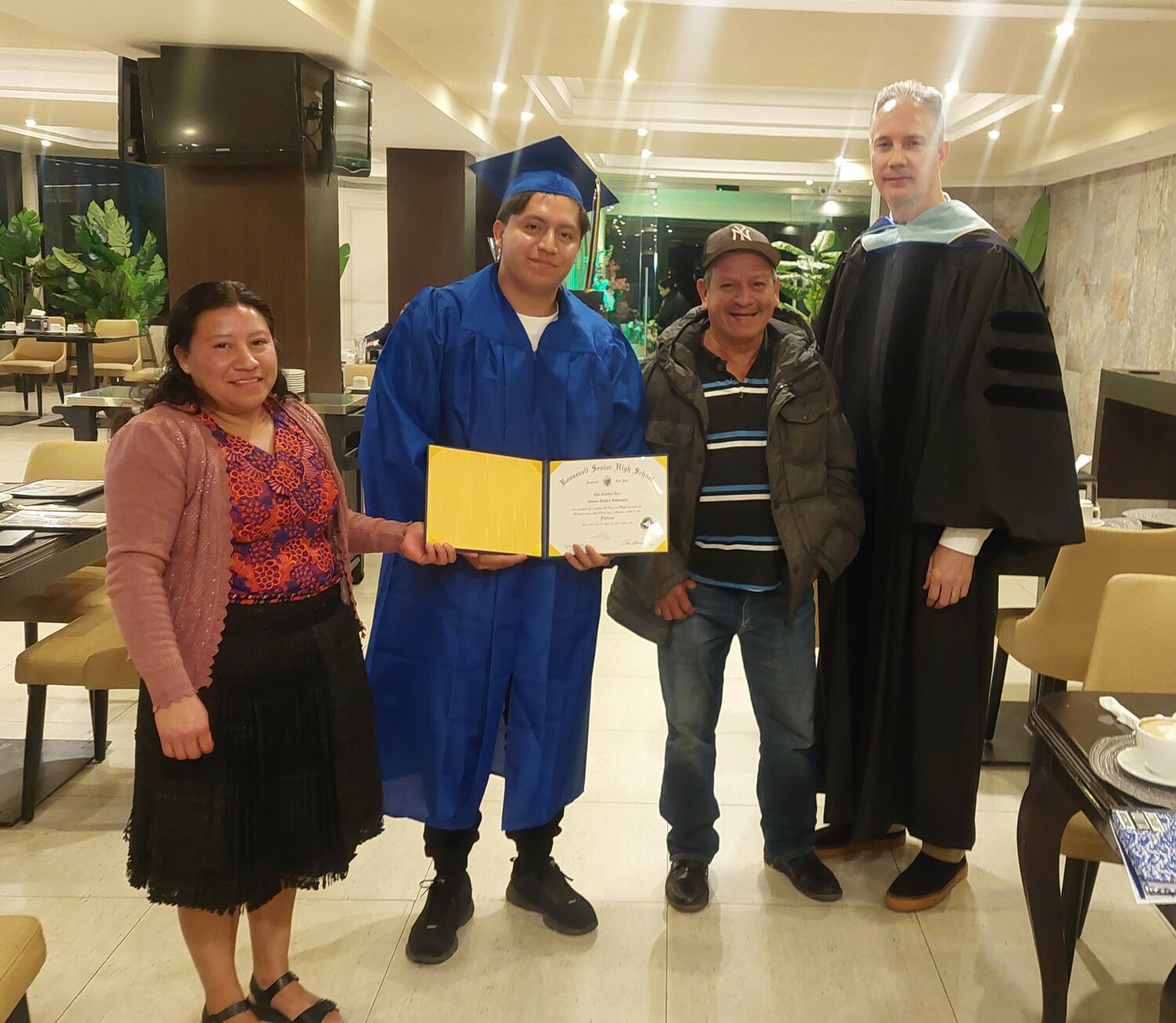


Almost a year after Immigration and Customs Enforcement agents detained him, former Roosevelt High School student Alvaro Castro Velasquez, 20, finally was handed his diploma on March 18 by Superintendent Shawn Wightman, who traveled to Guatemala at his own expense to personally deliver it to him.
Velasquez’s detainment, in late spring of 2025, a few weeks before he was set to participate in Roosevelt High School’s commencement ceremony on June 27, shook much of the Roosevelt community and added another anecdote to ICE’s complicated and controversial notoriety as the agency has expanded its activity across the United States in the past year.
In Roosevelt, a community with a Hispanic population of about 40 percent, many questioned how this could happen to a young man who was well liked by peers and had no criminal record.
“It should never happen to anyone,” Jessica Harrison, Velasquez’s former history teacher, said. “He’s just such a good person and just such an asset to any society, and we all felt so lucky to know him.”
Harrison shared that her students were “terrified” when word first got out of his detainment, and that his and others’ arrests have affected the behaviors of much of the Hispanic community in Roosevelt, which feels targeted by ICE’s actions.
“It affects every aspect of their life,” Harrison said. “They’ve told me that they’re scared to take out the garbage. They’re scared to go to and from school. A lot of them take taxis. A lot of them don’t want their parents driving them because God forbid.”
Attendance at Roosevelt High School has been impacted over the last year, Harrison explained, with students often missing extended days of classes out of fear of running into ICE on the way to school or elsewhere. Wightman added that Roosevelt schools have allowed several students to take classes online due to uncertainty around the documentation of themselves or relatives.
According to Wightman, Velasquez had initially been allowed to enter the U.S. legally in 2022 from Guatemala through the U.S. Department of Health and Human Services’ Exchange Visitor Program when he was 16 and lived with his old brother in Roosevelt. However, Velasquez fell out of legal favor after failing to maintain proper documentation for his status since he was still not a U.S. citizen.
A statement in 2025, while Velasquez was in a ICE detention facility in Texas, from Department of Homeland Security Assistant Secretary for Public Affairs Tricia McLaughlin justifies the arrest, stating that Velasquez should have never been allowed in the country to begin with.
“Alvaro Castro-Velasquez is an illegal alien from Guatemala who illegally crossed the southern border and was apprehended by U.S. Border Patrol May 6, 2022,” McLaughlin wrote. “Castro was released into our country by the Biden administration. ICE arrested Castro June 1 pursuant to a warrant of arrest.”
Wightman promised during the 2025 Roosevelt High School graduation that he would hand-deliver his diploma to him, since he had already been cleared to graduate prior to his arrest. Wightman attempted to get the diploma, Velasquez’s transcript and other documents to him after paying for a trip to Texas at his own expense but was told by ICE officials at the facility that detainees could not be handed anything.
Wightman refused to be deterred, however. Velasquez was given the opportunity to self-deport and return to San Marcos, Guatemala, which he did, giving Wightman the chance to finally reunite with the student and bring him his diploma, graduation regalia and more on behalf of the Roosevelt School District.
“I wanted to ensure that he got the diploma, it being so important and something that he’s earned,” Wightman said. “The other part is (I wanted to) give him the experience of wearing his gown and partake in the commencement ceremony. He didn’t get that opportunity.”
Wightman was unable to definitively state when Velasquez was released from ICE custody and self-deported.
While he acknowledged the legal mandates that ICE has regarding undocumented immigrants, Wightman expressed dissatisfaction and disappointment in how the system has treated Velasquez and other students in similar circumstances.
“To me, it just seems like an injustice is being done to individuals who are taken out the schools and then placed in detention centers for months on end, whereas they could be here to at least complete what it is that they’ve started here, and at least finish the year out,” Wightman said.
Wightman expressed hope that the U.S. would develop ways in which immigrants who are contributing positively could gain or maintain legal status without extended detainments or deportations. He described Velasquez as a shining example of a positive member of the Roosevelt community, since he was a quality student, held a job at the Roosevelt Field Mall and never had any other issues with the law.
Velasquez currently works with his father, processing Guatemalan coffee and working nearly 12 hours a day with few days off. Wightman said that Velasquez told him he makes about 100 Guatemalan quetzals a day, which equals $13.08 in U.S. currency, a “respectable” amount for the country’s standards.
Following the 2024 U.S. presidential election when Donald Trump, known for his aggressive rhetoric regarding illegal immigration, was elected for a second non-consecutive term, many students were fearful of his administration targeting migrant families. But Velasquez had a more nuanced perspective at the time.
“Alvaro’s response was, ‘Well let’s give him a chance. Maybe he’ll do better than we think he’s going to do for us,’” Harrison said. “And that kills me too, but that’s the kind of person he is.”
Harrison described the experience of dealing with Velasquez’s detainment as “traumatic” for many of the students, teachers and the wider Roosevelt community. Since his return to Guatemala, Harrison has managed to keep in contact with Velasquez on a near weekly basis through Facebook Messenger.
True to his optimistic character, Velasquez has not been turned off from pursuing the American Dream and hopes to eventually return to the U.S. to attend college.
“He even mentioned the possibility of even becoming or joining the military, which I thought was kind of surprising considering what it is that he’s gone through,” Wightman said. “But he loves the United States. In the conversations that I’ve had with him, he sees a lot of tremendous opportunity here. There’s a lot of opportunities that he doesn’t have in Guatemala that he has here and a lot of freedom.”
If Velasquez does eventually return to the U.S., he will have plenty of relationships and bonds that he built in Roosevelt ready to reunite with him. Social media has helped him maintain some of his other Roosevelt friendships, and he also received a letter of support from Town of Hempstead Deputy Supervisor Dorothy Goosby, among the items Wightman hand-delivered to him, further illustrating how the Roosevelt community has rallied around him.


