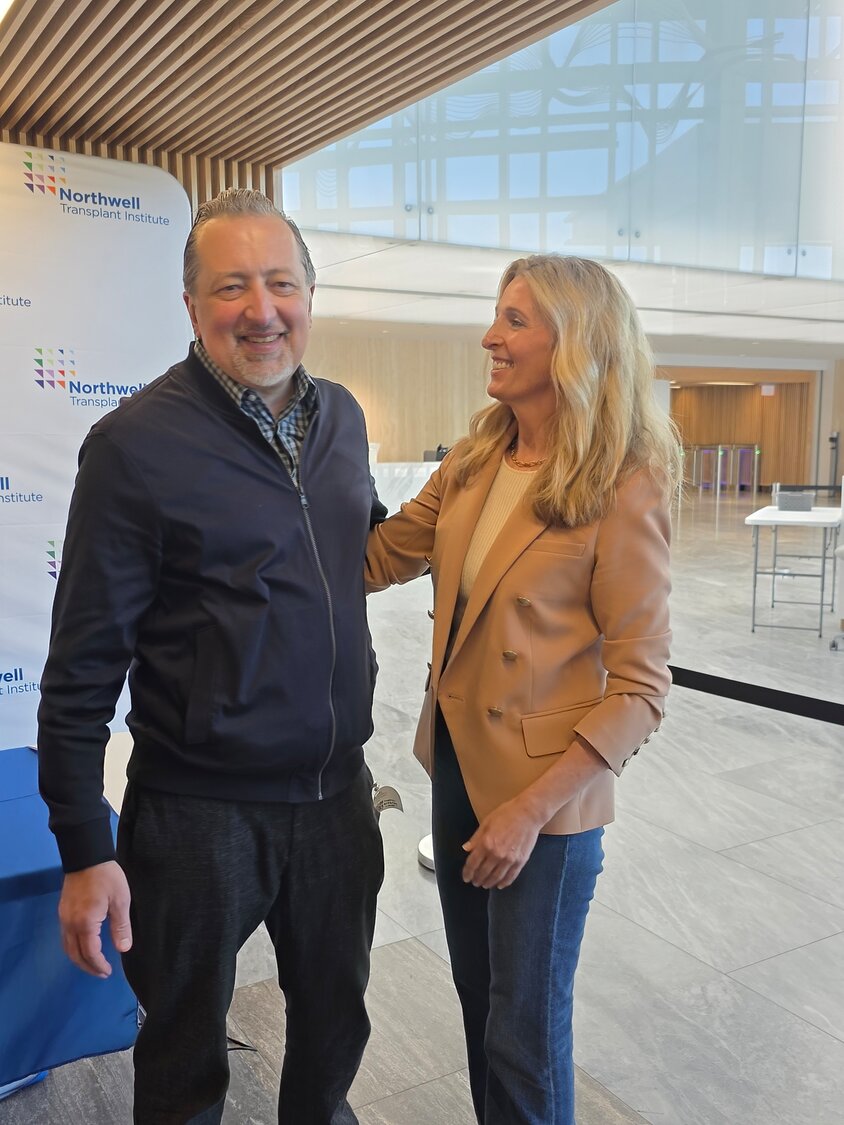
What began as a celebratory birthday dinner at a popular Glen Cove restaurant led to a life-altering moment when Susanne Deegan, of Sea Cliff, told La Bussola manager David Geliashvili, of Locust Valley, that she would get tested to see if she could donate a kidney.
Deegan and her husband, Daniel, were celebrating his 60th birthday on July 8, surrounded by family and friends at the Italian restaurant. As Susanne was enjoying a favorite dish, stuffed artichokes, the evening took a serious turn when Geliashvili revealed troubling news.
“He told us at the table he said, ‘I’m sick and I need a kidney,’” Deegan recounted. “I said, ‘I’ll get tested.’”
At the time, it was a spontaneous response. But months later, that pledge became a reality. After a series of medical evaluations, Deegan, 55, learned in February birthday that she was a blood type match with Geliashvili, 51. On March 10, they both underwent surgery at North Shore University Hospital, in Manhasset, and they reunited days later with the transplant team, marking the success of a procedure that ended over a year of uncertainty and physical stress for Geliashvili.
“There are not enough words for me to thank Susanne,” he said. “I call her my angel. There are angels among us.”
Geliashvili’s journey to a transplant began in the fall of 2024, when he began experiencing fatigue and shortness of breath. He initially believed he had the flu. But by December 2024, his condition had worsened, and he went to the emergency room, where doctors diagnosed him with polycystic kidney disease — a condition that had also affected members of his family.
Within days of his diagnosis, he began dialysis treatments, a demanding process in which he spent four hours every other day connected to a machine.
“Fourteen months, every other day,” Geliashvili recalled. “It’s tough, but I kept it to myself.”
Dialysis, transplant surgeon Dr. Elliot Grodstein, of North Shore University Hospital, explained, takes a significant toll on a patient’s daily life. “Dialysis drains blood out of your arm, the blood is cleaned by a machine, and then your entire circulating blood volume is replaced back into your body,” Grodstein said. “After such an extreme experience, you’re left feeling tired. Many patients feel nauseous, and they spend the rest of their day in bed.”
Despite the strain, Geliashvili continued working and maintaining as much of his routine as possible. He was placed on the transplant waiting list — one of more than 700 patients in the Northwell Health system and part of a national list exceeding 80,000 people.
The long wait times highlight the importance of donors, Grodstein said. “The real solution is to get a living donor,” he said, adding that patients can otherwise wait years for a transplant.
Dr. Aaron Winnick, who assisted with the surgery, said that living-donor transplants offer immediate benefits. “Once the kidney is in, it works immediately,” Winnick said.
Finding a living donor, however, can be the most difficult part of the process. “It’s a tough ask to say to somebody, ‘Are you willing to undergo a surgery to save my life?’” Grodstein said.
That challenge is something Northwell’s Living Donor Ambassador Program is designed to address. Libbie Binkiewicz, a living donor ambassador, helps patients navigate conversations about donation and reach out to their communities.
“We’ve started an amazing program here at the transplant center, which allows really very unique and personalized support that’s given to our recipients,” Binkiewicz said. “It’s a big ask to ask for an organ, but we’re not necessarily asking for an organ. We’re asking people for help.”
Binkiewicz said that Geliashvili stood out from the beginning. “He was motivated, and I knew that this was a guy that wanted to live,” she said.
Deegan and Geliashvili are more than just casual acquaintances. For over 20 years, her family had celebrated milestones at La Bussola, where he was a familiar and welcoming presence.
Deegan knew little about living donation, but was surprised to learn that patients often wait six to seven years for a kidney.
After about four months of testing, she and her husband were told that she and Geliashvili were a match, and they shared the news with him over FaceTime.
“I kind of lost it,” he said. “How do you react [to] that? It’s very hard to describe the feeling.”
For Deegan, the decision to donate an organ was deeply personal. “I would say that it’s one of the greatest things I’ve ever been able to do in my life,” she said.
She took issue with the idea that organ donation should be limited to close family members.
“A lot of people say, ‘Well, how could you do that?’” Deegan said. “I would say that every person is a stranger . . . they have their own loved ones. You’re not donating to a stranger. You’re donating to somebody’s mother or son or brother or wife or husband or grandmother.”
Since the surgery, and both donor and recipient have recovered well. Geliashvili said that aside from a follow-up hospital visit, his recovery has been smooth.
Now, both he and Deegan are encouraging others to consider living donation, hoping their story will inspire similar acts of generosity.