
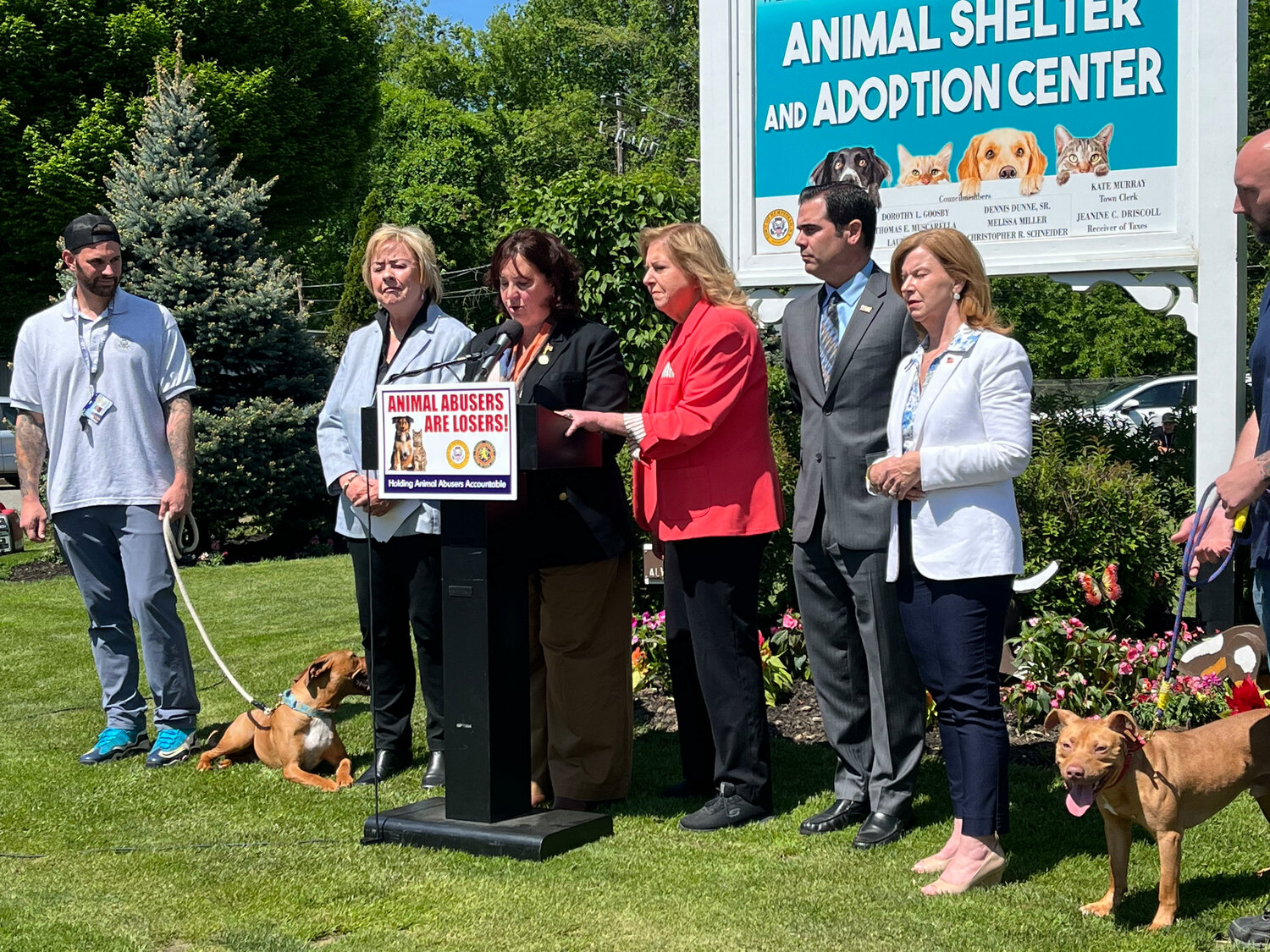
Local officials are looking to change New York’s bail reform laws to allow judges the discretion to detain defendants accused of aggravated animal abuse.
At a news conference at the Town of Hempstead Animal Shelter in Wantagh on May 12, Nassau County District Attorney Anne Donnelly called for the repeal of cashless bail in crimes involving animals. According to Donnelly, under current state law, aggravated cruelty to animals — a felony under Section 353-a of the Agriculture and Markets Law — is not a bail-eligible offense. As a result, those charged with animal abuse are typically released with nothing more than appearance tickets, she said.
“Aggravated animal cruelty is not a violent offense because it’s not labeled as such, but it is violent,” Donnelly said. “When you hurt and torture an innocent animal who can’t speak for him or herself, that is a violent act.”
Joining Donnelly at the shelter were State Sen. Patricia Canzoneri-Fitzpatrick, County Legislator John Ferretti, Town Councilwoman Laura Ryder and Town Clerk Kate Murray. Together they called on state lawmakers to repeal parts of the cashless bail law that they say prevent the justice system from holding dangerous offenders accountable.
In 2019, the state implemented a bail reform law that eliminated cash bail for most misdemeanors and some non-violent felony charges. According to the Brennan Center For Justice, a nonpartisan law and policy organization that works to reform and revitalize legal policies, bail reform aims to address inequities in the criminal justice system so that those who can’t afford bail can maintain employment and housing, which could reduce the likelihood that they will become repeat offenders.
But Canzoneri-Fitzpatrick said that the policy prioritizes criminals over victims, and called for restoring judges’ and prosecutors’ ability to hold dangerous offenders accountable. She cosponsored Senate Bill S1648, which would make aggravated animal abuse a bailable offense, but it was rejected by the Senate Codes Committee on May 5, effectively halting its progress in the current legislative session.
“We need action,” Canzoneri-Fitzpatrick said, “and that’s why I’m proud to stand here with these other elected officials who are pushing for the same common-sense reforms that we need to protect our communities.”
Gary Rogers, president of the Nassau County Society for the Prevention of Cruelty to Animals, supported the legislation, stating in a news release that the proposed changes are overdue.
“Animal crimes is a very serious crime,” Rogers stated. “It is a precursor to other violent crimes. It is our responsibility to protect the voiceless animals and society from the depraved acts of an animal abuser.”
Ferretti, a Levittown resident and a Republican candidate for Hempstead town supervisor in November’s election, is no stranger to animal legislation. In 2019, his dog, Benny, was attacked by a neighbor’s loose dog. Benny survived, but as a result, Ferretti authored Benny’s Law, which requires owners of dogs that have been judicially deemed dangerous to notify neighbors within a 1,000-foot radius and register the dog in a county database. The goal, he said, was to prevent future attacks by alerting residents to potentially dangerous animals.
“I've been committed to the welfare of animals during my career in the Nassau County Legislature,” Ferretti said, “and continuing that work with District Attorney Donnelly is something that is truly very important to me.”
At the news conference, Donnelly highlighted a recent case in Albany, in which a man and woman accused of starving and setting a dog on fire were released without bail, despite the severity of the alleged crime.
According to the Albany County district attorney’s office, Christopher Maxwell and Latisha Ellis allegedly left their dog alone for nearly two weeks before it was found dead and burned in a crate in a parking lot. They were arraigned in April on multiple charges, including aggravated cruelty to animals, and pleaded not guilty. They were released under supervision and barred from possessing animals.
“A person who would starve a dog and set it on fire — you don’t think it’s dangerous to let them out on the streets?” Donnelly asked. “That is what I’m calling for. Let the judges have the discretion to see what the person did, and make a decision from there.”


