By JOSEPH KELLARD
A retired internist who worked at South Nassau for 40 years, Michtom decided to go to the hospital and learn about the clinic, and he met up with his former colleague, Robin Grass, director of South Nassau's Department of Community Medicine, who runs the 18-year-old clinic.
It offers a day where children can bring their teddy bears or another stuffed animal to be treated for minor emergencies such as cuts, broken bones, a respiratory problem or high fever.
Members of South Nassau's nursing, pediatric, family medicine and community medicine staffs explain to children, from ages 4 to 7, the steps they take to determine the injury or illness and how to treat it. The staff demonstrate on the stuffed animals the procedures or techniques -- casting, X-raying, and suturing -- that will help heal wounds or treat the conditions.
"The Teddy Bear program is a great way to educate children about the procedures most often performed on people their age, and it helps reduce their fears of undergoing these procedures," Grass said.
The clinic usually involves students from Oceanside and Rockville Centre, and kindergarten students from School 6 in Oceanside attended the most recent program, held in the hospital's conference room on Friday, April 12.
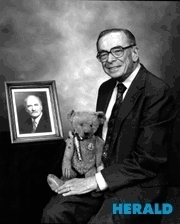
On that day, Michtom, a 19-year resident of RVC who Grass said is regarded as an "endearing doctor" at the hospital, was invited to celebrate the teddy bear's 100th birthday. He took the opportunity to tell the children the tales behind his grandfather's creation and naming of the stuffed animal. Accompanying him were some of the many books he owns that chronicle the toy's history, including "The Teddy Bear Book" by Peter Bull and "Teddy Bear Men" by Linda Mullins.
The origin of the teddy bear stretches back to a widely publicized cartoon of Teddy Roosevelt. In 1902, the 26th President was hunting in Mississippi and one of his companions captured a black bear cub, tied it up and brought it to Roosevelt to shoot. He found no challenge in this opportunity and spared the cub's life. A reporter traveling with him telegraphed the story to the Washington Post. The following day, the paper ran a front-page cartoon by Clifford Berryman that showed the president declining to shoot the cub, and the caption accompanying it read: "Drawing the line in Mississippi."
At the time, Morris Michtom owned a candy store in East New York.
"The story is that my grandfather saw the cartoon and he and my grandmother sowed a teddy bear, and fixed the arms so they were movable in some way, and put it in their store window," Michtom explained. "He wrote to Teddy Roosevelt asking if he could use his name. He received a letter telling him that he could go ahead and do it. Someone who was possibly a merchandiser saw the stuffed bear in the window and realized it would catch on."
During the late 19th century, the Steiff family in Germany made stuffed animals, and around the time Michtom was creating his bear, Richard Steiff attended a circus where he saw trained bears performing for the crowd. He drew a concept of a toy bear and showed them to his aunt, Margaret Steiff, who owned the family's toy and doll company. She designed a stuffed bear and exhibited them at the 1903 Leipzig Toy Fair. Like Michtom, Richard had seen the cartoon and started calling them teddy bears as well.
In contrast to Europe, however, the stuffed animal became enormously popular in the United States after the merchant at Michtom's store began to market them. Their marketing success allowed Michtom to open the Ideal Novelty and Toy Corporation in Brooklyn. Its main factory was in East New York, Brooklyn, and in the mid-1930s it was moved to Queens near the Queensborough Bridge, and later to Jamaica.
"It became so big, he gave up the candy store and went into the factory," Michtom said.
While Morris employed several relatives in various capacities, Robert worked in the factory's shipping department for only one week when he was 13.
"The Shirley Temple doll that was made in the mid-1930s was a huge success. It put me through college and medical school," Michtom laughed.
Through the years Michtom has been contacted to talk about his experiences with and knowledge about his grandfather and his creation of what is perhaps the most enduringly popular toy in America. Linda Mullins had contacted him when she was in the process of creating a Morris Michtom bear for the teddy bear's 100th anniversary this year.
"My time spent at the teddy bear clinic was fun and pleasant," Michtom said.