
Wednesday, October 21, 2026
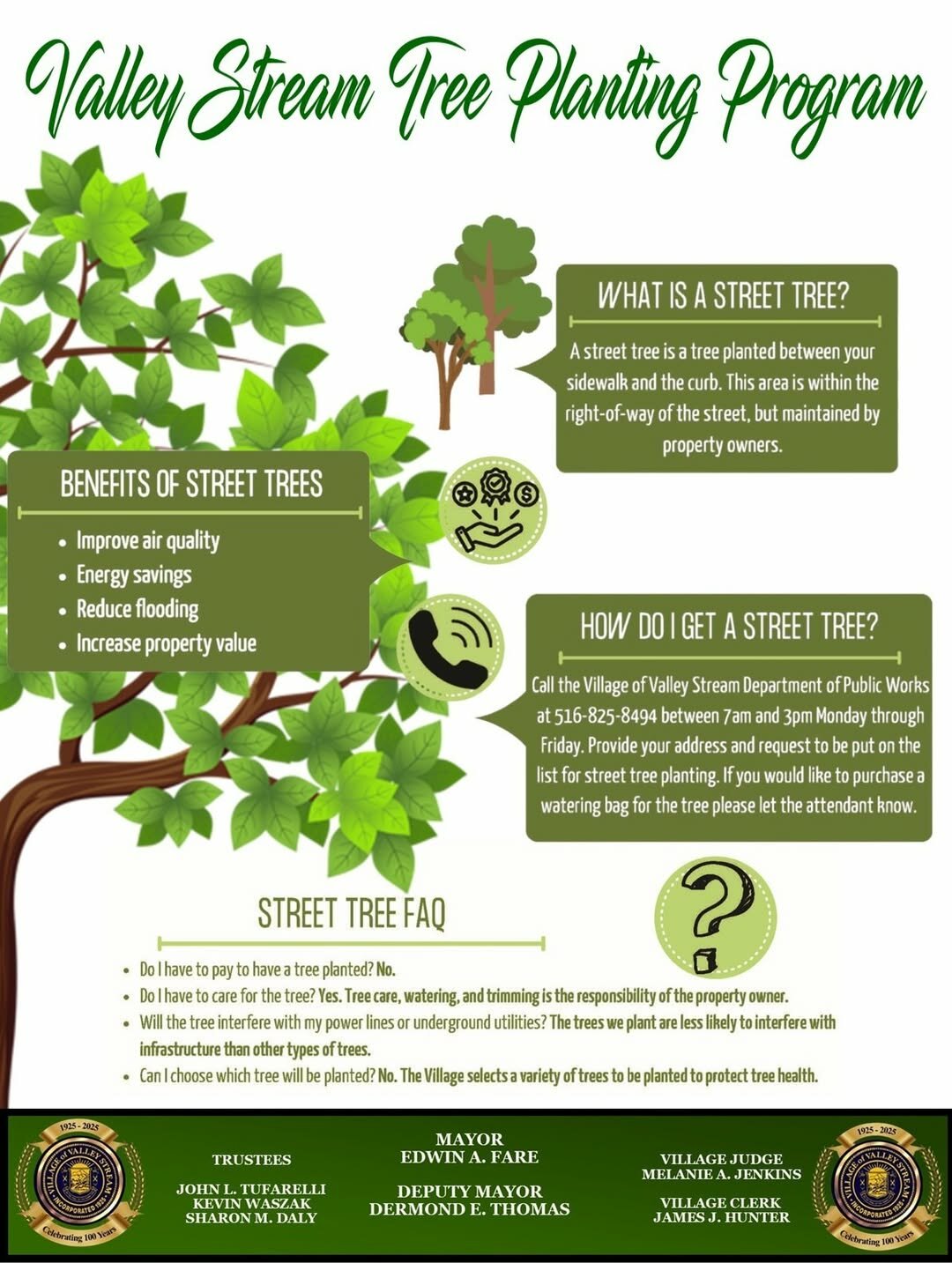
The Village of Valley Stream has been vigorously promoting its street tree-planting program — a longstanding initiative that has been active for decades — as the village works to replenish its aging tree population and enhance community green spaces.
The village’s Department of Public Works oversees the program, which is not new. In fact, Valley Stream holds a Tree City USA designation, reflecting the village’s commitment to urban forestry and ability to meet strict tree care milestones. The program has long been focused on planting trees while minimizing unnecessary removals.
The village’s longtime commitment to urban forestry is continuing under the guidance of Steven Acquavella, Public Works superintendent, who oversees efforts to sustain and renew the village’s tree canopy as part of ongoing community maintenance.
“And like everything else, trees have a life cycle as well, and they don’t last forever, unfortunately,” Acquavella said. “So we have been looking around in the parks and on the streets, and we focus on a lot of the areas that are a little bit more bare than anywhere else in the village.”
Residents can request a tree — planted between their sidewalk and curb — at no cost by calling Public Works at (516) 825-8494. Those residents are placed on a rolling waiting list, which means requests are never refused but may be fulfilled in the following planting season if demand exceeds supply. Planting typically occurs from November through January.
The village plants roughly 185 trees annually, funded through its own budget with strong backing from Mayor Ed Fare and the Board of Trustees, who view tree planting as a priority for beautifying the community. In addition, Valley Stream pursues grants and accepts donations from organizations and banks, often partnering with volunteers for larger planting events.
“We get all these trees in, but we are always seeking funding for more and additional trees,” Acquavella said. “That’s what keeps our parks going. We always plant new trees in the parks, and we plant at least 185, usually more than that, usually over 200 trees just for the residents.”
When a tree is removed, whether by the village or homeowner, replacement is mandatory. Residents who remove trees from their property must replant an equivalent number on their land. Those who decline must contribute to the village’s tree fund, which finances planting in parks and other public areas. This is done to ensure that the village’s tree canopy continues to grow, even if some residents opt out of planting on their property.
Tree species selection is carefully managed to avoid issues with the surrounding infrastructure. The village plants “wire-friendly” or “street-friendly” trees that typically grow between 30 and 50 feet tall, minimizing interference with overhead power lines and underground utilities. Popular species include Yoshino cherries and Japanese Zelkova, which are among the different varieties planted. While residents can request specific tree types, final selection depends on whether they are available and suitable for their location.
Tree care after planting is the responsibility of the homeowner. To assist, the village offers watering bags that residents can purchase. These bags are designed to be filled weekly, providing consistent moisture to support young trees’ survival. Residents also are advised to protect trees from damage caused by lawn equipment, such as weed whackers, by using protective wraps around trunks.
The village hires an outside company to plant most of its trees, guaranteeing replacement if a tree dies within the first year. Beyond that, the village replaces dead trees at no cost to residents, reinforcing its commitment to maintaining the urban canopy.
Valley Stream residents have shown overwhelming interest in the program. The rolling waiting list remains open year-round, allowing continuous planting efforts without turning away requests. This steady demand underscores the community’s appreciation for the environmental, aesthetic and property value benefits that street trees provide.
Trees also improve air quality by filtering pollutants, reduce energy use by providing shade, mitigate flooding by absorbing stormwater and enhance property values. These environmental and economic advantages support Valley Stream’s broader sustainability goals.
“In the past, we’ve taken trees,” Rich DeAngelis, the village’s deputy clerk, said. “People have brought us trees, maybe saplings that they were kind of growing. We have a large oak tree in front of the pool, and the squirrels end up burying all those acorns, and we’ll dig up the little saplings and nurture them until they get to a point where they’re big enough to be planted again. So not only are we buying them, but when we have the opportunity and we can, we grow our own and make sure that we get them out there for everybody to enjoy.”
Volunteer groups, schools and local organizations often join village staff during planting events, fostering a shared sense of stewardship over the village’s green spaces.
Valley Stream’s street tree-planting program reflects a long-term commitment to preserving and growing its urban forest. By replacing aging trees, engaging residents and prioritizing environmental benefits, the village said it aims to sustain a vibrant, healthy canopy that enriches the community.


