
Thursday, October 22, 2026
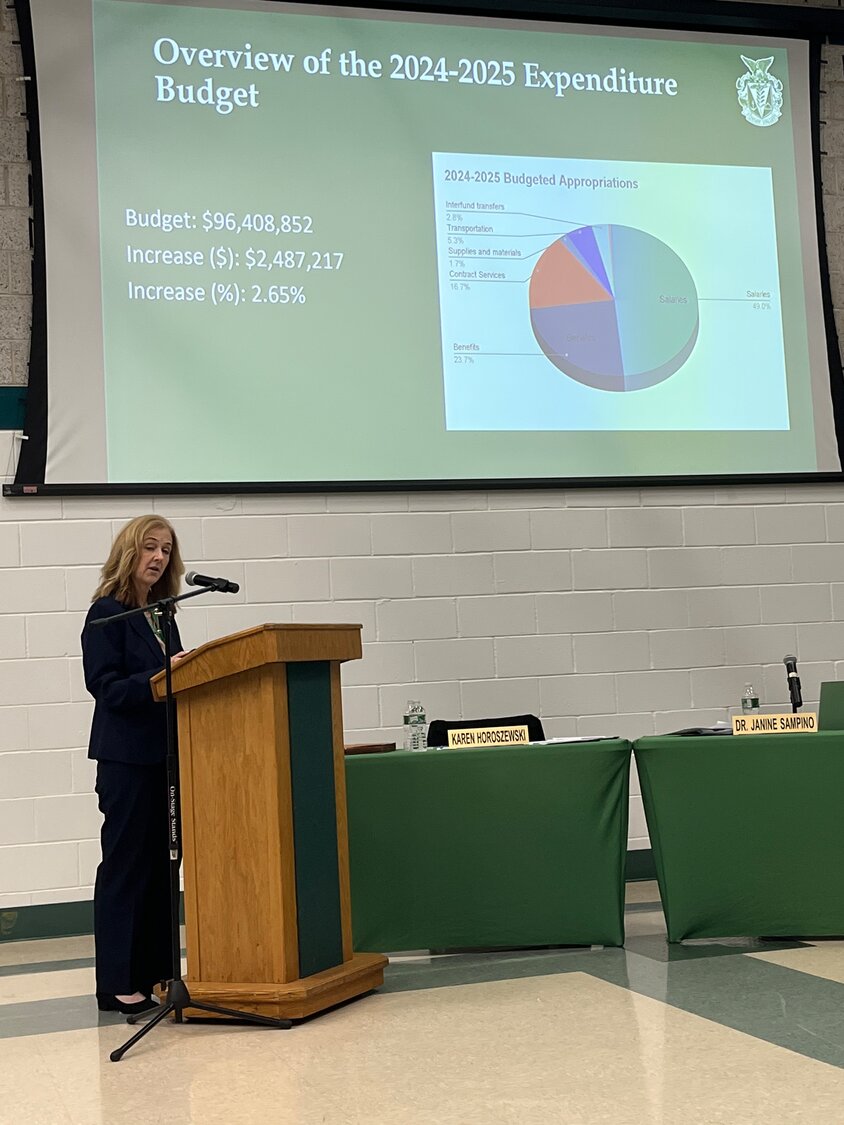
The Locust Valley Central School District held its fourth budget meeting on Wednesday night, at which Karen Horoszewski, assistant superintendent for business, detailed the district’s financial plans for the 2025-26 school year. Addressing an array of topics from tax caps to capital projects, Horoszewski offered insights into the district’s financial health and future expenditures.
“I just want to apologize for those who have seen my other presentations,” she joked at the start. “I’m repeating myself quite a bit, but I think it’s important to start at the beginning.”
Horoszewski began by highlighting next year’s projected spending plan, totaling $98 million, an increase of roughly 1.9 over the current year. A significant portion, roughly three-quarters, of the budget is allocated to staff salaries and benefits. Tax revenue will cover just over 91 percent of spending, with an additional $5.6 million coming from the state.
The discussion turned to the state’s property tax cap, implemented in 2011 to limit annual tax levy growth for local governments and school districts. Next year the district will once again keep the tax levy increase to 2.3 percent, which will accommodate necessary expenditures such as capital projects and debt service.
“You can see that we are well within the range for our district,” Horoszewski said. “We recognize the importance of (the tax levy’s) impact on our community, our balance and the reserve.”
Fund balance, a critical measure of financial health, was detailed in four categories: non-spendable, restricted, assigned and unassigned funds. As of June 2024, the district’s fund balance stood at just under $26 million, with the unassigned portion comprising 4 percent of this year’s budget, in accordance with state regulations. Horoszewski also underscored the district’s fiscal prudence, stability and flexibility in financial planning.
The presentation detailed employee benefits, noting an increase next year of roughly $300,000 due to contractual obligations and adjustments in the State Retirement System. And capital projects were another topic, including renovations and infrastructure improvements across district facilities. Proposed projects included the renovation of the middle school-high school cafeteria and the installation of a multi-sport artificial-turf field at Bayville Intermediate School.
These initiatives will be funded by a combination of capital reserve withdrawals and transfers from the general fund, underscoring the district’s commitment to making improvements without impacting the tax levy.
“This proposition that will ask for the withdrawal from the capital reserve is simply a request to withdraw money from a savings account,” George Vasiliou, vice president of the Board of Education, emphasized after the presentation. “This money is there, and this money is there to be spent on projects like these. We’ve done enormous amounts in this district in terms of our infrastructure and more day-to-day operational facility work, and it’s our chance to do something a little bit more innovative, to do something a little bit more forward-thinking, less utilitarian, a little bit more of a statement project.”
Looking ahead, Horoszewski outlined the timeline for budget adoption and community engagement, with key dates including the April 22 budget adoption and issuance of the property tax report card, culminating in the May 20 school board election and budget vote.
“Thank you Karen,” board President Lauren Themis said. “We appreciate that you’re so intelligent, that you’re somebody who understands all those numbers, and that you can present them in such a fantastic way. So thank you for all your hard work, and your department.”
For more information on the district budget and upcoming meetings, residents are encouraged to visit the district website, LocustValleySchools.org, or attend the next board meeting, scheduled for April 22.


