
Friday, October 23, 2026

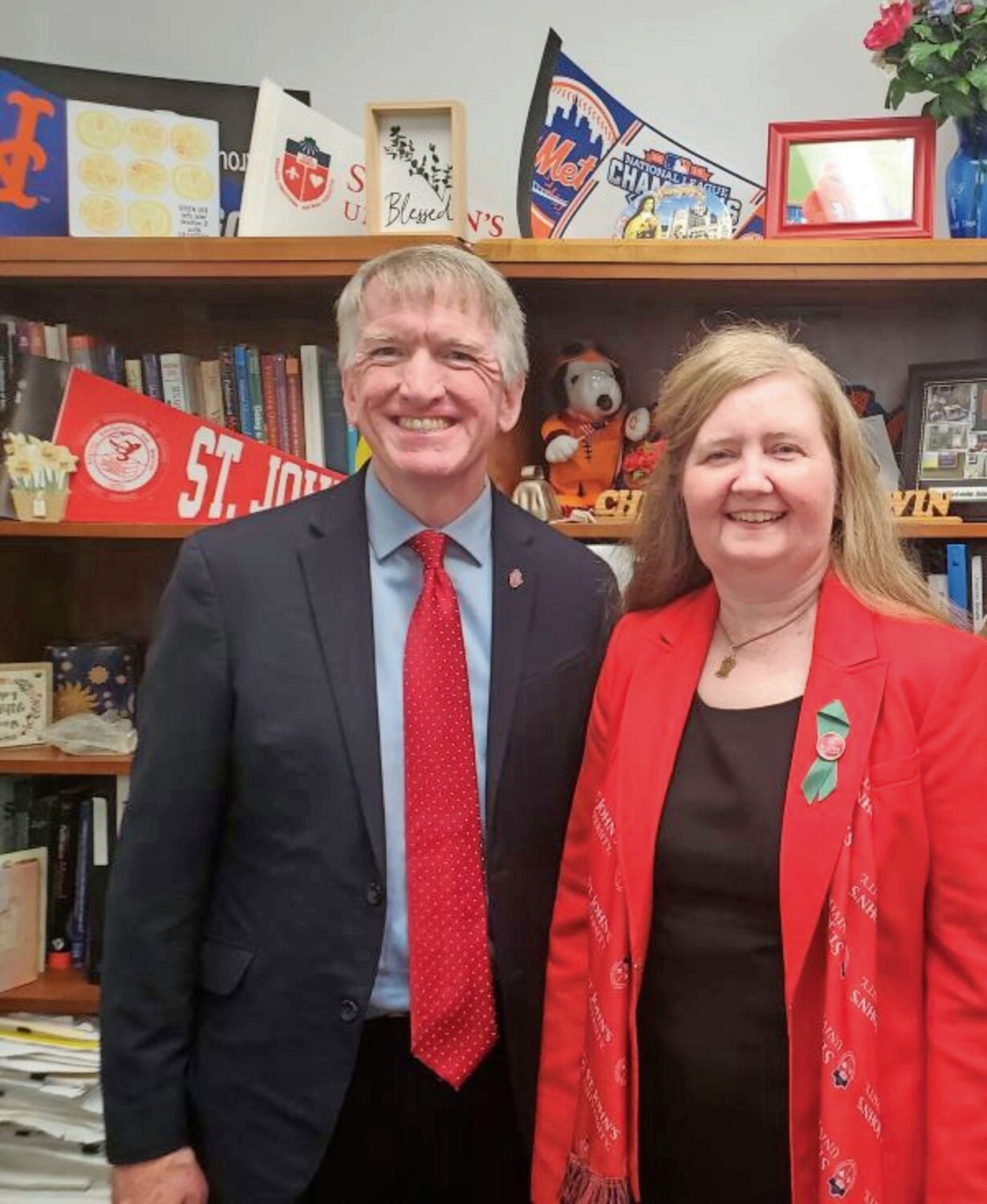


For most of her life, Christine Goodwin has quietly persevered through a health battle that began when she was a teenager.
Now, more than three decades after she received a lifesaving kidney transplant from her father, the South Hempstead resident and St. Agnes Cathedral School graduate is once again searching for a kidney donor — and leaning on her faith, her community and a large network of supporters for help.
Goodwin, 52, a St. John’s University administrator and a parishioner at St. Agnes, was first diagnosed with kidney failure at age 15, during her freshman year at Sacred Heart Academy in Hempstead.
“I was just feeling very tired and weak,” she recalled. “So one day I just felt like I couldn’t go to school anymore, so I went to the doctor, and they did tests and saw I was in kidney failure. I was immediately hospitalized and placed on dialysis.”
Both of her parents were tested as potential donors. While both were matches, her father, John, ultimately donated a kidney to Christine in November 1989, at Boston Children’s Hospital.
The transplant was a success, allowing her to return to a relatively normal life — though not without challenges. Sacred Heart played a critical role in supporting her at the time, ensuring that she stayed on track academically despite frequent hospital visits.
“Well, just like anyone, this doesn’t happen to us. It happens to someone else,” Goodwin said. “But our mentality is, like, ‘OK, we’re just going to keep going forward, one foot in front of the other, and do what it needs to do.’ The Sacred Heart community was fantastic.”
Thanks to that support, she graduated on time, and went on to earn a B.S. in math in 1996, and eventually a master’s in library science, an Advanced Certificate in library and information science and a doctorate in instructional leadership, all from St. John’s, later building a career there as an assistant provost for institutional research.
For years her transplanted kidney functioned well, but in 2023 doctors determined that it had began an irreversible decline, meaning that another transplant would eventually be necessary. Goodwin is now working with Northwell Health’s transplant team to identify a living donor — the preferred option, because it offers better outcomes and can significantly reduce wait times compared with a deceased-donor transplant.
“A second kidney transplant is not as uncommon as we think,” Libbie Binkiewicz, program manager and living donor ambassador at Northwell Health’s Transplant Institute, said. “Transplanted kidneys do not last forever. They’re kind of like batteries … kidneys from a living donor, on average, last 20 years.”
Binkiewicz, who works closely with patients like Goodwin, helps guide them through the process of finding a donor, using personal networks and outreach efforts.
“The wait list is years long,” she said. “Which is another reason why we put forth so much effort to help her find a living donor, so that she doesn’t have to wait.”
Binkiewicz emphasized the urgency of acting before dialysis becomes necessary.
“Christine is currently not on dialysis, which is our ideal patient,” she explained. “While dialysis is lifesaving, it’s not healthy for the body, and comes with a terrible quality of life. If she had to start dialysis, it would significantly disrupt her career and daily routine, leaving her feeling tired and sluggish. That’s why we’re putting so much effort into finding a living donor now — to avoid dialysis and transplant her while she’s in her healthiest state.”
Despite the challenges, Binkiewicz remains hopeful.
“I am so optimistic,” she said. “She has cultivated a professional network as well as a personal network that is so incredibly admirable.”
That network has already begun to mobilize. At St. John’s, Goodwin’s colleagues have been raising awareness of her situation — including Brian Browne, associate vice president for university communications and public affairs and a friend of Goodwin’s since their undergraduate days.
“I think no one deserves it better than her,” Browne said. “Christine is just a real giving person who thinks of others first. She doesn’t talk about herself. She doesn’t talk about her situation. She’s other-centered first.”
Goodwin was honored with a Special Recognition Award at Sacred Heart’s 20th annual Leadership Dinner Dance on March 20 — Browne serves on the dinner committee — for her contributions and dedication to the school and to Catholic education.
The support reflects what Browne described as a broader spirit of unity among those who know Goodwin. “If the role was reversed, and if she had a kidney to give, she would do it,” he said.
As she awaits a match, Goodwin continues to live her life as fully as possible — working, attending St. John’s basketball games, looking forward to Mets games and staying active in her parish — all while managing regular medical monitoring. She also hopes her story will inspire others to consider becoming living donors.
“People with only one kidney can live a very active, healthy life,” she said. “Even if maybe they can’t help me, they can help someone else and be a hero, and be a lifesaver.”
Goodwin faces the uncertainty of what lies ahead not with fear, but with faith — the same steady belief that has carried her from a hospital bed at 15 to a full and active life decades later.
“I know God is with me,” she said. “And I know with God, anything is possible. And we will get through this. And I have faith that we will find a donor.”
Anyone interested in learning more about kidney donation or being evaluated as a potential living donor can contact Binkiewicz at (516) 666-0899 or LBinkiewicz@northwell.edu.


