
Thursday, October 22, 2026

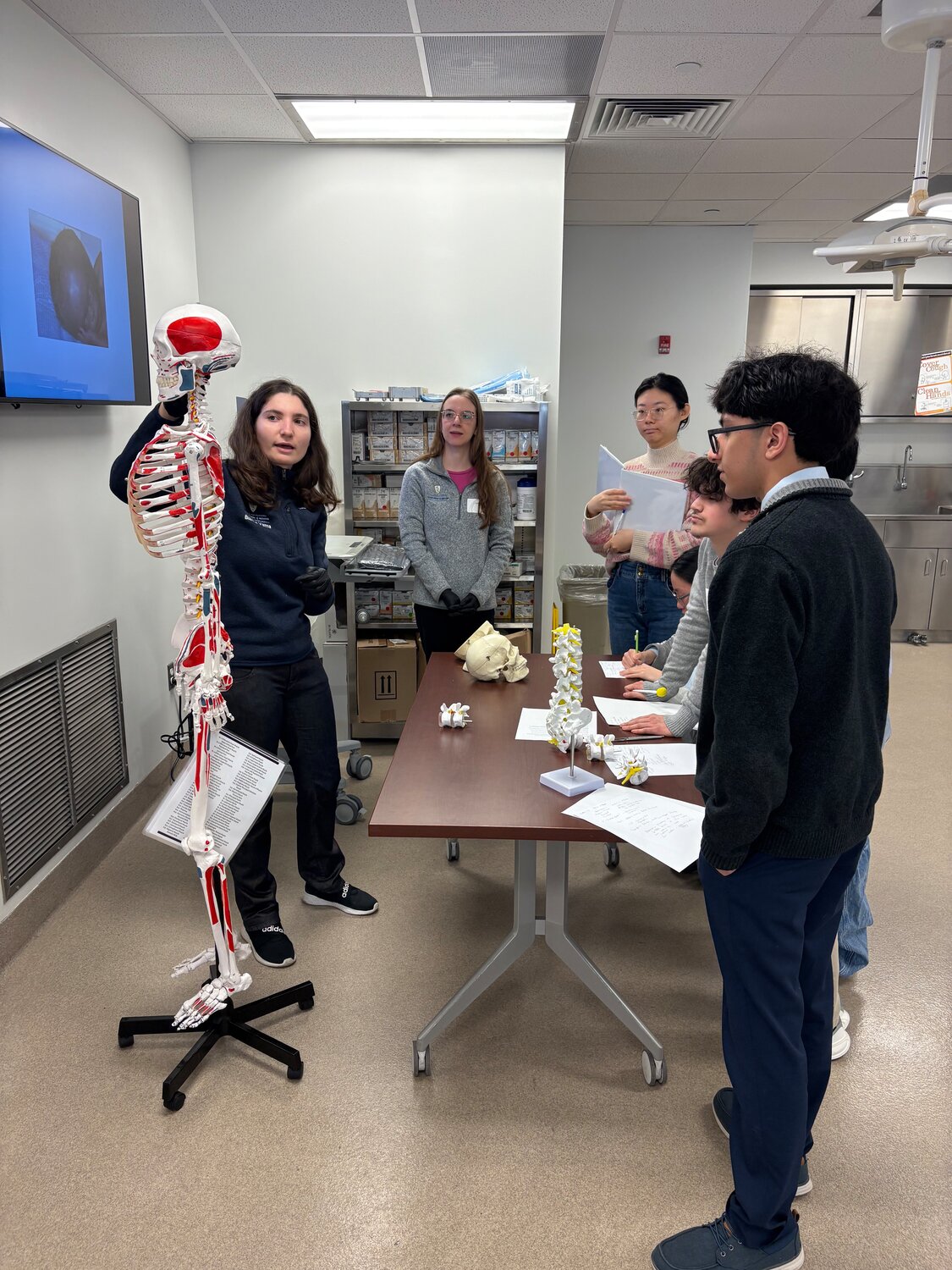


More than 50 high school students from across Long Island gathered at the Donald and Barbara Zucker School of Medicine at Hofstra/Northwell for the annual Brain Bee competition last Saturday, studying real brain specimens, exploring neuroscience concepts and hearing from physicians and medical students working in the field.
Students moved through a series of educational stations in the school’s anatomy lab, where they examined skulls, spinal cords and preserved human brains while learning about the nervous system from medical students and neurologists. The two-part competition included a multiple-choice test on brain facts and the identification of anatomical structures and functions in real human brain specimens.
Among the participants was Locust Valley High School sophomore Daniyel Asim, who said he has been interested in medicine, and specifically neuroscience, for years, because both of his parents are physicians.
Before entering the lab, Asim said he was nervous about seeing real brain specimens for the first time. “I was mostly worried about it,” he said. “[But] I calmed myself down, and it was easy.”
Dr. Robert Hill, an associate professor of science education at the Zucker School of Medicine who helped organize the event, said the students had hands-on opportunities to study anatomy and see how the brain works.
“This station is about the bony anatomy associated with the nervous system,” Hill said while showing students models and specimens. “… These are just plastic models with the spinal cord inside, but most of the rest of these stations have actual brains that came from our body donors, either a whole brain or a brain that’s sliced in different ways to show deeper structures inside the brain.”
Each station was manned by medical students who guided their younger peers through the material and answered their questions. Hill added that a benefit of having medical students leading the exercises is that they remember what it felt like to be a high school student interested in medicine, and can better connect with them.
“Some of these students actually have to take their final exam on brain anatomy in . . . a couple of weeks,” Hill said, “so they see it as ‘I’m studying for this by being here at the Brain Bee.’”
Hill also emphasized the importance of treating the organs, given by donors, with respect, and teaching students to appreciate the donors’ generosity. The Oath of Gratitude, written by Zucker School of Medicine graduate Dr. Brooke Milosh, along with other classmates who are members of the national Gold Humanism Honor Society, is posted on a wall at the entrance to the lab: “We thank and honor you, our donors, with the understanding that your bodies will teach us lessons that cannot be taught in any book. We are humbled by your gracious gift, and we pledge to treat you with the utmost reverence as you help us learn and grow into compassionate, humanistic physicians.”
“Reflection is one of the core values of the medical school, and as we define it, it’s just taking time to think about and process the emotions that come with intense clinical experiences,” Hill said. “And even though, in this case, the patient is deceased already, students come to think of their body donor as their first patient, and taking time to reflect on that as an intense clinical experience is an important part of what we do.”
At another station, students learned about the meninges, the protective layers surrounding the brain and spinal cord, as well as the Circle of Willis, a network of arteries that supply blood to the brain.
Organizers explained how blockages in those arteries can cause strokes, and how an aneurysm forms when a blood vessel wall weakens and bulges.
Dr. Brian Emmert, an assistant professor of neurology at the Columbia Epilepsy Center and a graduate of the Zucker School of Medicine, led a station focused on epilepsy and seizures. Emmert, who took part in the Brain Bee as a medical student, said that introducing students to neuroscience early can spark a lasting interest in the field.
“I think it’s important to get people interested early,” he said, “and honestly, a lot of this stuff is really cool for them. How often do you get . . . to come into the lab to look at people’s brains and learn about neuroscience in a very safe and interesting environment?”
The demand for neurologists continues to grow, Emmert said, as the population ages.
“I think it really whets people’s appetite and stimulates people’s interest early, and that really helps develop the next generation,” he said. “We need people in those fields, because a lot as people age, neurodegenerative diseases are becoming more prevalent.”
Emmert said he was impressed by the high school students’ desire to learn and the breadth of their knowledge at such young ages. “You could tell that they came prepared,” he said. “. . . It always impresses me how well-prepared and interested the students who come to the session are.”
Asim, the Locust Valley High sophomore, said the experience expanded his understanding of neuroscience.
“Everything was very important to me,” he said. “I learned about the eye structure also, which was significant, because I thought, we’re going to mostly only cover the central nervous system, but we also covered peripheral and other systems.”
He also appreciated the chance to meet medical students and professionals working in the field he hopes to enter.


