
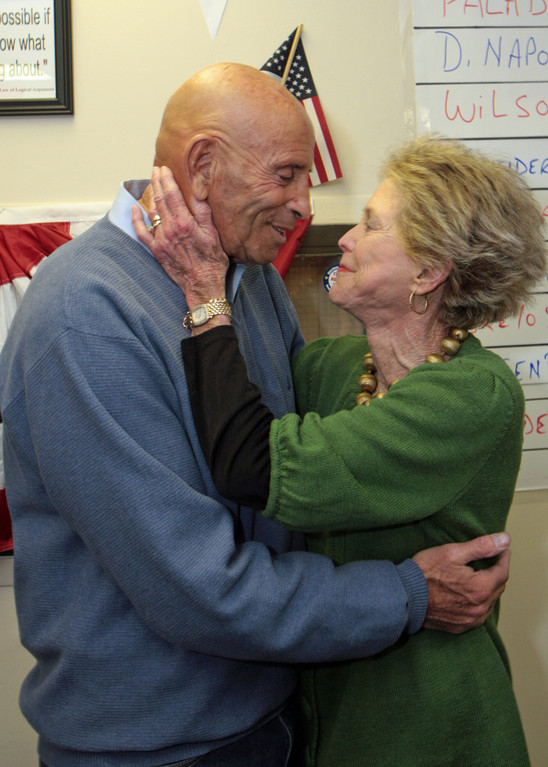
At around 9:30 Tuesday night in one voting precinct, Democratic State Assemblyman Harvey Weisenberg had 216 votes, and his GOP challenger, Josh Wanderer, had 109, according to results being tallied at Democratic Committee headquarters on West Park Avenue.
“That was my badge number,” said an elated Weisenberg, 76, recalling his days as a Long Beach police officer. More than 50 of his supporters packed the small room while Michael Zapson, the committee’s president, posted the results.
Weisenberg, who was vying for an 11th term as a representative of the 20th A.D., had good reason to be hopeful, since he was well ahead of Wanderer, of Lawrence. In the end, after months of campaigning and heated debates with his opponents, the lifelong Long Beach resident captured 52 percent of the vote, with 18,989 votes to Wanderer’s 17,194.
“I thank everybody who put in the time and effort so that our voice will continue to be heard in Albany,” Weisenberg told his supporters. “Everybody from our community worked together to share our success tonight.”
The anticipated nationwide wave of incumbent-ousting didn’t make it all the way to the South Shore this Election Day, as most current office holders — both Democrats and Republicans — retained their seats. According to unofficial results from the Nassau County Board of Elections early Wednesday morning, U.S. Rep. Peter King (R-Seaford) trounced Democrat Howard Kudler in the 3rd Congressional District race, Rep. Carolyn McCarthy (D-Mineola) defeated Republican challenger Francis X. Becker of Lynbrook in the 4th C.D., and State Sen. Dean Skelos (R-Rockville Centre) beat George Sava, a Democrat from Woodmere.
“What a difference two years makes,” said Skelos. “Right here on Long Island … the nine Long Island Republicans are back.”
With a possible statewide shift in the Senate back to the Republicans, the news got even better for Skelos, who could return as the majority leader.
For Weisenberg, the win means that he will continue to fight for his district, he said, especially as the state grapples with a deficit of more than $9 billion and a 10 percent unemployment rate. “I know what it is to be up there when you have a deficit,” he said. “You have to find the revenues where you can and cut down without impacting the quality of life for people.”
Despite his loss, Wanderer, a tax attorney, said he was proud of his first bid against a popular 21-year incumbent. He attacked Weisenberg as an opponent of change in Albany and for failing to deliver sufficient state education aid, And, like Weisenberg’s primary challenger, Jeff Toback, Wanderer accused Weisenberg of bilking the state pension system by collecting both a pension and a salary.
“It was the first time Harvey faced a serious opponent,” Wanderer said. “In the last midterm election he won it by over 15,000 votes. We were under an 1,800-vote spread. It should send a message to the powers that be in Albany that the people are not happy with the status quo and that the politicians need to start looking out for the needs of their constituents.”
Throughout the campaign, Weisenberg disputed those accusations, saying that he had earned his pension, was doing nothing wrong and could have retired 10 years earlier but did not.
At a debate sponsored by the local League of Women Voters at the Long Beach Library on Oct. 28, Weisenberg noted the schism between the needs of Long Island residents and those who live upstate, saying that he fought against tax increases and cuts to health care and education.
Both candidates touched on the current economy as well as the importance of Long Islanders’ quality of life. Voters’ major concerns, according to Weisenberg, were, “One, don’t raise taxes; two, don’t cut education funding; and three, don’t cut health care.” Weisenberg explained that he would do none of those things.
Asked how he would reduce taxes, Wanderer offered his solution: cut spending and cut taxes. He also said that if New York were to become more business-friendly, more companies would come to the state. As a result, the tax base would be broader and unemployment would drop.
In response to Wanderer’s plan, Weisenberg asked, “We’re going to lower taxes and we’re going to cut spending, and you’re going to see consequences when you have a nine-billion-dollar deficit. Where are your revenues?”
In the months leading up to the election, Weisenberg touted his record in Albany, sponsoring nearly 300 bills, including legislation helping people with special needs and creating tougher DWI laws — an example of which is Leandra’s Law, which was crafted through what he described as his bipartisan work with Assembly Speaker Sheldon Silver, along with other Democrats and Republicans.
Weisenberg said he has worked to restore $600 million of Governor Paterson’s planned $1.4 billion cuts in school aid this year, and that since he took office in 1989, state education aid to local schools has increased by 86 percent. He also said that he steered roughly $1 million in discretionary funds to public schools.
“I think the right person won,” said Long Beach resident Karen Adamo. “Harvey does look out for Long Beach, and we’re lucky to have him.”
Shortly before the final votes were tallied, Weisenberg said he was confident that he would be re-elected. “The results are obvious: We have an economic crisis in our state and people are looking for change,” he said. “But change will only be effective if experienced people work together.”
Chris Engelhardt contributed to this story. Comments about it? Arifilato@liherald.com or (516) 569-4000 ext. 213.


