
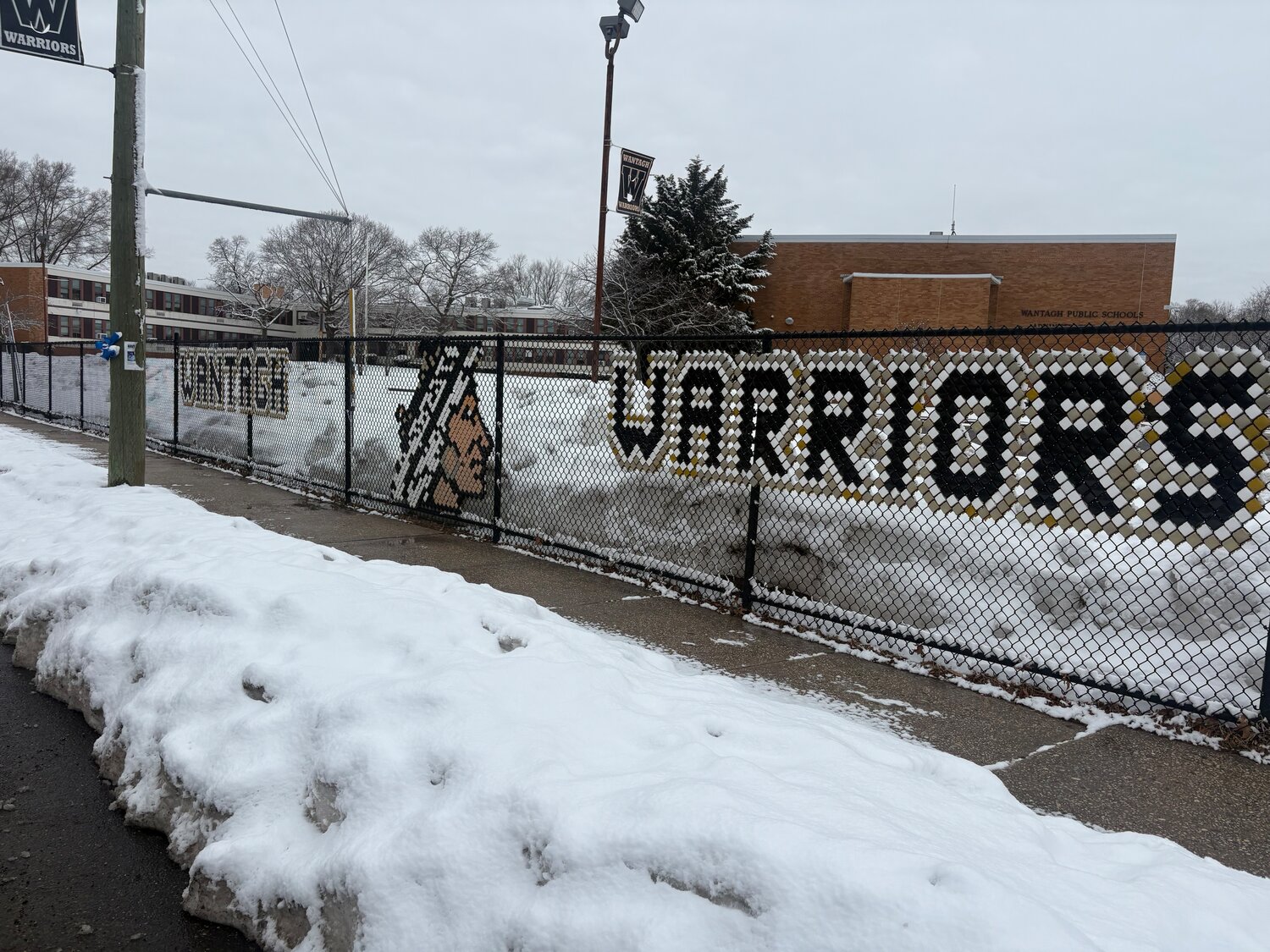
A bill that would exempt Wantagh School District from New York state's Native American mascot ban has moved forward in the Senate, providing proponents with renewed hope that the Warriors identity could be preserved.
State Sen. Steve Rhoads, whose district includes Wantagh and Seaford, said the legislation recognizes what he describes as Wantagh's unique historical connection to the name that has represented the community and its schools for decades.
The bill would excuse Wantagh from a state mandate requiring schools to cease using Native American mascots, logos, imagery or team names.
The measure recently moved from the Senate’s Education Committee to its Investigations and Government Operations Committee, one of the final steps before it could reach the Senate floor for a vote. If the State Legislature passes the bill, Gov. Kathy Hochul could then sign it into law.
"We're in the last two weeks of session," Rhoads said. "What I've encouraged residents to do is to reach out to Senator (Jessica) Scarcella-Spanton and Senate leadership to get this onto a committee agenda and bring it to the floor so that we can get this piece of legislation passed."
The state Education Department's mascot mandate, adopted in 2023, requires districts to comply with the ban or risk losing state aid. Wantagh, whose teams have long competed as the Warriors, has challenged the regulation through state and federal litigation while also seeking legislative relief.
Earlier this year, the district received a one-year extension from the state, allowing it to continue using the Warriors name through June 30, 2027. In a Feb. 10 letter to the community, members of the Wantagh Board of Education said they remained committed to preserving the Warrior identity while continuing legal challenges in both state and federal court.
"We understand how deeply the Warrior identity is woven into the fabric of the Wantagh community," board members said in the letter. "Your ongoing support and input have been the driving force behind our efforts."
Rhoads argued that Wantagh's circumstances differ from those of other districts because the community itself was named after a historical figure.
According to Rhoads, Chief Wantagh was the Grand Sachem of the Montaukett tribe, signing a 1657 land compact with early settlers that helped resolve territorial disputes and facilitated settlement throughout much of what is now Wantagh, Seaford and neighboring communities.
"Wantagh's unique circumstance is the fact that the town was named after not just a person or a tribe," Rhoads said. "It was named after an actual individual."
The area's original name was Jerusalem, later becoming known as Ridgewood before residents selected the name Wantagh in 1891 when a new post office was established and another Ridgewood already existed in Queens.
When Wantagh High School opened in 1956, Rhoads said, school leaders chose the Warriors name to honor that local history.
The district has also incorporated that history into its educational programs. Rhoads recalled that students learned about Chief Wantagh and the Montaukett people as part of the district's seventh-grade curriculum.
"The district actually put in, as part of their seventh-grade curriculum, an entire section on the local history of Wantagh, including teaching about Chief Wantagh and the Montaukett Indians," he said.
While the legislation would exempt Wantagh from the state's mascot ban entirely, district officials have indicated they may still choose to retire Native American imagery while preserving the Warriors name, Rhoads said.
In recent years, the district has already reduced its use of Native American imagery on new purchases as legal challenges continue. New signage and equipment have generally emphasized the school's "W" logo rather than traditional mascot imagery.
Rhoads said conversations with representatives of the Montaukett community focused largely on the historical accuracy of mascot imagery rather than objections to the Warriors name itself.
One concern, he explained, involved whether details in the mascot's headdress accurately reflected Chief Wantagh and Montaukett traditions.
At the same time, supporters of the exemption argue that forcing a rebrand would impose significant costs on taxpayers. District officials have indicated that the price tag could approach $1 million when accounting for uniforms, athletic fields, gymnasium floors, signage and other materials that would need to be replaced, Rhoads said.
"These are substantial costs," he said, "which should be put into educating our kids."
The legislation also arrives amid broader legal questions surrounding the state's policy. Rhoads noted that the U.S. Department of Education has examined whether singling out Native American mascots while allowing other ethnic or historical group references to exist could raise federal civil rights concerns.
For now, however, the future of the Warriors name remains uncertain.


