
Thursday, October 1, 2026
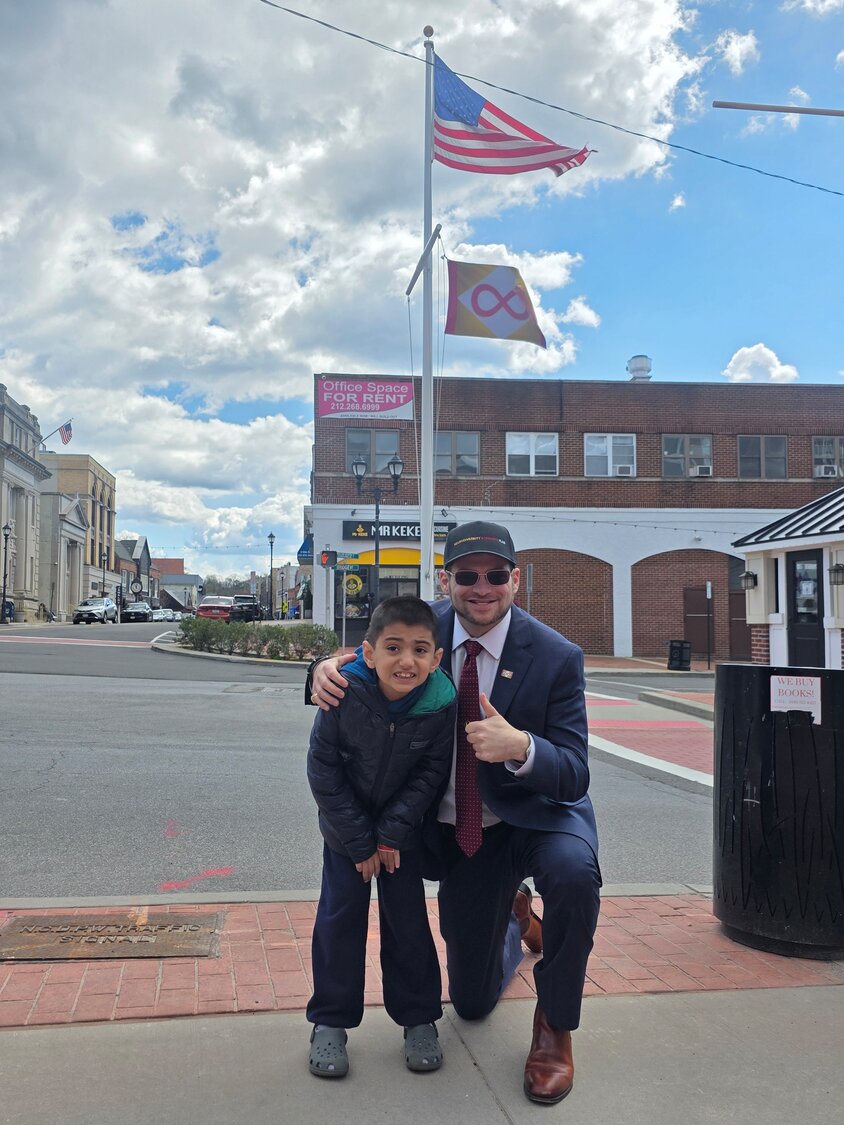
The movement to redefine how New Yorkers understand neurodiversity is gaining momentum — and much of that progress can be traced to one advocate’s vision. For Josh Mirsky, 33, a Jericho resident who is on the autism spectrum, a vision took shape in the form of a flag — bold in color, direct in message and designed to challenge longstanding stigmas.
“I was bullied tremendously — I already faced all this bigotry when I was a kid,” Mirsky said. “There are deep-seated societal stigmas … and these are the kinds of things I’m trying to change.”
Mirsky’s design, known as the Neurodiversity Strength Flag, which was raised in Glen Cove on Tuesday, features a red and gold color scheme with an infinity symbol set inside a diamond.
Each element carries meaning: Red represents power and resilience, gold signifies value and equality, and the infinity symbol reflects the wide spectrum of how neurodivergent people think, learn and behave.
“It’s meant to be bold,” he said. “It’s meant to be almost in your face, because that’s the only way to make change.”
What began as a personal mission has evolved into a statewide movement. In 2021, the New York State Office for People With Developmental Disabilities launched a design contest to create an official symbol for neurodiversity awareness. Nearly 40 submissions were considered, and people with special needs helped select the final design — Mirsky’s.
Since then, the flag has steadily gained recognition across New York. This year marks a major milestone: For the first time, landmarks around the state are being illuminated in red, white and gold in honor of Neurodiversity Acceptance Month.
“This is a massive win for every single neurodivergent person in the state of New York,” Mirsky said.
Behind that progress is a growing coalition of advocates and public officials working to elevate the message of inclusion — including Assemblyman Charles Lavine, who has been instrumental in supporting Mirsky’s efforts.
Lavine, who represents parts of Oyster Bay, has helped bring the initiative into the public sphere, coordinating local events and advocating for broader recognition at the state level. Though he was unable to attend the flag-raising ceremony in Glen Cove because of his legislative obligations in Albany, he emphasized the importance of the movement in a statement.
“I am very proud of Josh Mirsky’s efforts to promote the understanding that each of us learns differently and that it is our responsibility to guarantee that everyone is treated with respect and equality,” Lavine wrote in a statement.
Mirsky said that kind of institutional support has been critical — not just in advancing awareness, but in ensuring that the effort remains inclusive and effective.
“A very beautiful thing which is happening is I’m noticing it’s becoming bipartisan,” he said. “Because if it becomes partisan, then you’re going to have one side not wanting it, then the other.”
At the state level, officials have embraced the initiative as part of a broader shift in how neurodiversity is discussed and understood.
Willow Baer, commissioner of the Office for People With Developmental Disabilities, said the flag represents more than awareness; it signals a move toward recognition and celebration.
“I am so proud to fly New York’s Neurodiversity Strength Flag to represent belonging for the tens of thousands of self-neurodiverse New Yorkers who add value to our families, workplaces, and communities,” Baer wrote in a statement. “The new colors of red, white, and gold shift the narrative from one of acceptance to one of celebration.”
That shift reflects a broader understanding of neurodiversity itself. The concept encompasses conditions such as autism, dyslexia and attention-deficit/hyperactivity disorder, and defines them as natural variations in brain function rather than deficits.
Advocates say that perspective is essential — not only in reducing the stigmas associated with those conditions, but in creating more inclusive schools, workplaces and communities.
For Mirsky, the mission remains deeply personal. He often speaks about the importance of confronting stigmas head-on and encouraging others not to internalize negative perceptions.
“Don’t hate yourself, because you can always figure stuff out,” he previously told the Herald. “Lots of times people hate themselves because they internalize all the stigma, and that never turns out well.”
By creating a bold symbol, Mirsky hopes to spark similar change for the neurodivergent community. Years after first bringing his idea to Lavine, he said that the growing recognition of the flag — from local ceremonies to statewide displays — is both validating and motivating.
“It took a lot of hard work every day,” he said. “But it’s worth it.”


