
Thursday, October 1, 2026


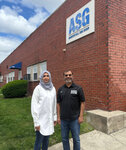
For Abbas Jaffer, the sign manufacturing business is more than a career — it is a family legacy that stretches back decades.
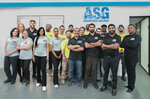
Jaffer, 58, the owner of Architectural Sign Group Inc., in Elmont, has spent decades building a company rooted in craftsmanship and family. What began as a small operation started by his wife in their home has grown into a regional manufacturing business employing more than 30 people and contributing to some of the metropolitan area’s most recognizable transportation projects.
But the story of Architectural Sign Group began long before it was founded in Elmont.
Jaffer’s family’s involvement in the industry dates to 1954, when his uncle Aunali Khalfan started Tanzania Sign Writers in Tanzania, East Africa. The company produced municipal and traffic signs, and gradually built a reputation in the region.
In 1968, the year Jaffer was born in Tanzania, his father was killed in a bus accident, and in the early 1970s Khalfan emigrated to New York with his sister, Abbas’s mother, and the young boy. Khalfan established Sign & Decal Corporation in Queens, and today, Architectural Sign Group is now a third-generation business legacy, with both of Jaffer’s sons involved in the company as well.
Growing up, Jaffer was immersed in the family trade. Summers were spent working on the shop floor, learning about manufacturing and seeing firsthand how the company operated.
After graduating from Caldwell College, now Caldwell University, in New Jersey in 1990, Jaffer worked briefly in the family business before going to work for Visual Graphic Systems in Manhattan. There, he spent 15 years as a project manager, gaining experience on the corporate side.
Architectural Sign Group, founded by his wife, Rehana, in 2001 as a home-based business, took a major step forward in 2010, when the couple rented a shop in Elmont and began building a manufacturing operation. “We started from scratch, just me and her,” Jaffer said.
In the years since, Architectural Sign Group has completed work on several major infrastructure projects across the region. Among them are Moynihan Train Hall and Terminals One, Four and Six at John F. Kennedy International Airport, as well as Long Island Rail Road stations and projects for the Port Authority of New York and New Jersey.
Elizabeth Forbes, an active member of the Elmont community and the founder of Gift of Giving Foundation, a nonprofit dedicated to advocating for underserved communities, recalls Architectural Sign Group’s efforts during the coronavirus pandemic to keep its employees on the payroll.
“I remember during Covid, they kept their staff of the same guys,” Forbes recalled, adding of Jaffer, “He paid their salary out of his pocket during Covid. He literally took money from his own home to pay them.”
Jaffer remembered contracts being delayed during the pandemic. But even as work was lost, he said, the company chose to keep workers on staff rather than reducing its workforce. “Even though we lost some contracts,” he said, “we held on to all our employees.”
Because the company was involved in infrastructure projects, it was designated an essential supplier and allowed to continue operating during the pandemic shutdowns.
The decision to retain employees, Jaffer said, ultimately helped position the company for growth once the economy came back to life. “We wanted to hold on to them,” he explained, “because when things turn around, if we lose them and we don’t have them, we won’t be able to make the product that we need.”
As the company expanded, Jaffer said, he also wanted to create opportunities for those in younger generations to learn about manufacturing careers. Architectural Sign Group now hosts a summer internship program for local high school students, typically involving 10 to 12 students per year, who rotate through the company’s departments and learn how projects move from design to production.
Many of the students, Jaffer said, are especially interested in the graphics department, where they have the chance to work with large-format printers and advanced design technology.
Architectural Sign Group also operates as a Minority and Women-Owned Business Enterprise. The designation, Jaffer said, has helped provide access to major public infrastructure projects while also motivating the company to consistently exceed expectations.
“It’s very important,” he said of the Small Business Administration’s Minority Business Program. “[It] gives us access to these very large projects” that set aside a percentage of the work for minority businesses.
There are few minority-owned manufacturing businesses operating at the scale his company has reached, he said, which has made it imperative for the business to continually prove itself with quality work.
Jaffer credits much of the company’s success to his wife, whom he described as his strongest supporter. “She’s been my support and has been pushing me,” he said of Rehana. “She was very good with finance and I was very good with operations, so we mixed the two together.”
Today, with both of his sons, Ali Jaffer and Kumail Jaffer, helping lead the company, Jaffer said that Architectural Sign Group represents more than business success. To him, the company and its employees are part of an extended family — a continuation of a business legacy that began in Tanzania in 1954 and now, based in Elmont, is known throughout the metropolitan area.


