
Thursday, October 22, 2026
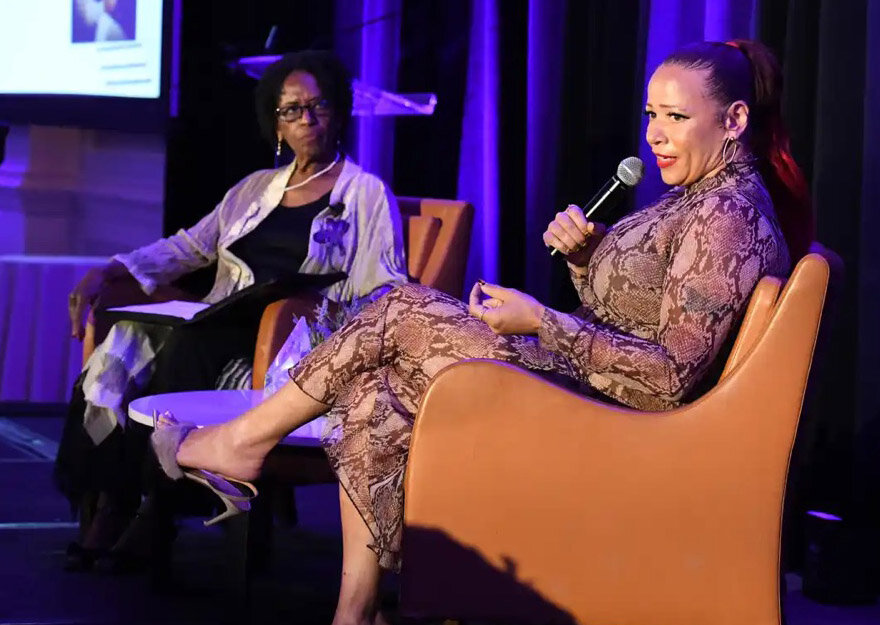
The Long Island-based advocacy group ERASE Racism held its 25th Anniversary Benefit event earlier this month, giving out awards for anti-racism and anti-discrimination work and awarding scholarships to students who embody the organization’s values.
Hundreds of guests crowded the Garden City Hotel on June 3 for a cocktail hour and to take part in ERASE Racism’s silent auction, where items ranging from artwork to lottery tickets were bid on for up to thousands of dollars. The funds will go to ERASE Racism advocacy initiatives for public education and housing equality.
Students Ria Bhatia, of Jericho High School; Edwin Montes Dubon, of Uniondale High; Zamari Paul, of Malverne High; and Janeiry Savinon, of New Hyde Park High, were each awarded $500 scholarships for winning a student essay contest. Malverne High student Matthew DaCosta was awarded the $1,500 John Wenzel Scholarship for his work with ERASE Racism.
Pulitzer Prize-winning journalist Nikole Hannah-Jones and activist Monique Fitzgerald were honored with special awards for their advocacy against structural racism. Hannah-Jones’s work on the 1619 Project, a New York Times Magazine and audio series examining the beginnings of American slavery and its generational effects, was highlighted during the program.
Hannah-Jones and Elaine Gross, ERASE Racism’s founding president, had a “fireside chat,” discussing how racism continues to impact life for minorities, particularly Black communities, on Long Island and across the country.
“This is a hard time for civil rights organizations, because there is a very organized and powerful effort from the highest reaches of the government that basically is saying there is nothing called structural racism,” Gross told the Herald before the event.
She identified an April settlement between the U.S. Justice Department and the Town of Oyster Bay over alleged housing discrimination as an example of structural racism on Long Island. In the case, which was settled in U.S. District Court, the town was found liable for “intentionally discriminating against Black individuals” by giving the children of current residents priority in purchasing housing units under its Next Generation housing program. This allegedly hindered the ability of Blacks and other racial minorities to buy homes in predominantly white Oyster Bay.
Hannah-Jones pointed out that racism on Long Island often is not a conscious effort by residents, but rather the result of the region’s historically discriminatory structure.
“You as an individual white person don’t have to be racist at all to have your housing choices and the benefits of your housing choices shaped by a structure that you have nothing to do with creating,” she said.
Talking more about the 1619 Project and contemporary racism, Hannah-Jones contended that the sanitized way in which many schools and institutions deal with America’s racist history is counterproductive to the goal of erasing racism.
“The truth about America is deeply heartbreaking,” she said, “but I find the truth to be a liberating thing, because one can confront the truth that everything that is within the law is constructed. If you know that it’s constructed, then you know it can be deconstructed.”
Hannah-Jones acknowledged that she was not very optimistic about race relations and how discrimination is handled in the U.S., citing the current administration as a reason for such pessimism. But, she and Gross said they believe that as today’s young people advocate for social justice, they have the potential to unlock a better future for Long Island and beyond.


