
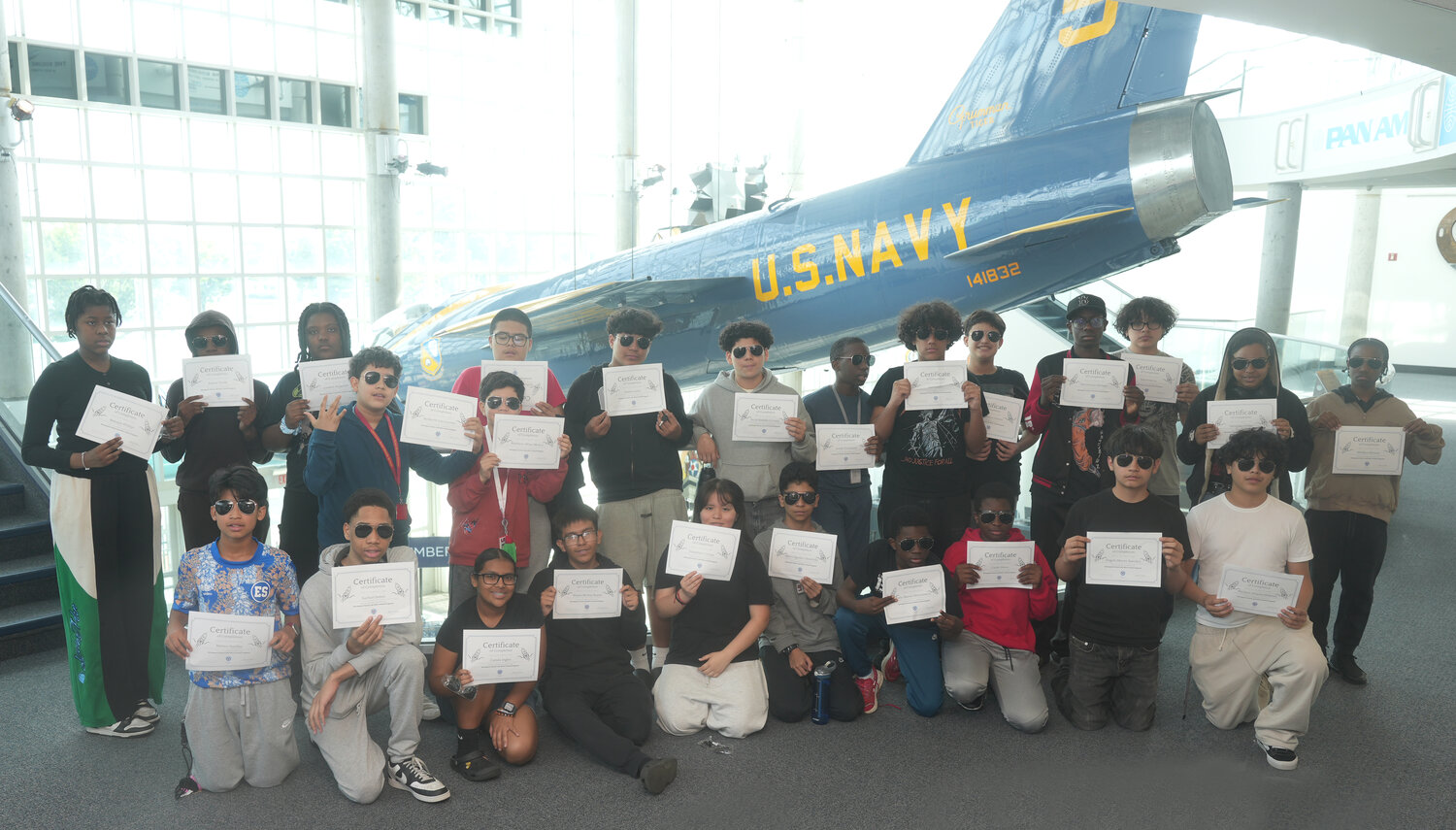


For 50 students from Uniondale’s two middle schools, the dream of flight took shape this spring through Future Lab, a 10-week, after-school enrichment program at the Cradle of Aviation Museum.
The partnership between the museum and the Uniondale School District introduced students to aviation and aerospace careers through hands-on STEM activities designed to make science, technology, engineering and math lessons more engaging.
Cassandra Mehu, the district’s assistant grant coordinator, said the program was viewed as an opportunity to expose students to careers they might not otherwise consider, particularly in aviation, engineering and aerospace.
“It was great to be able to partner with the Cradle,” Mehu said, referring to the Uniondale museum. “This is such a great thing for our students to be able to have that access and know that they too can be a pilot, they too can be an engineer, and they too can design planes.”
Future Lab also introduced students to P-TECH, a Vaughn College program that combines college coursework with career-focused studies in engineering and technology. At the end of the program, high school students receive an associate degree.
Mehu said Uniondale supported the partnership because it gives middle school students early exposure to aviation and technology careers before they reach high school, helping them better understand opportunities available through programs such as P-TECH.
Students from Turtle Hook and Lawrence Road middle schools were recommended by guidance counselors, with a focus on seventh and eighth graders who could continue exploring similar opportunities as they move onto high school.
Among the participants was Lawrence Road seventh grader Caleb Blanco, 12, whose fascination with airplanes began when he was a toddler. The program helped reinforce his goal of becoming an engineer.
“I would look at the sky, and I would see planes fly, and I was like, ‘I want to be in one of those things,’” Caleb said.
He added that through the program, students learned about aircraft components and how planes operate.
“They taught us a lot of things, like how the engine works, the rudder, which is the tail of the airplane, the stabilizers,” he said. “And how the entire airplane works.”
Drawing on his longtime interest in aviation, Caleb teamed up with two classmates to create a jet-inspired aircraft for the program’s final project. Using Tinkercad, a free web-based for 3D designs for beginners.
The students designed the plane from the ground up, applying lessons about aerodynamics, aircraft components and engineering principles they had explored throughout the 10-week program.
Camila Ingles, 13, who attends Turtle Hook, said she knew little about airplanes before joining Future Lab.
“I learned how to design and how planes actually fly,” Camila said. “I don’t think I will continue learning about aviation outside of school, but I would continue learning in programs like this.”
Sean Brass, an educator at the Cradle of Aviation Museum, said students entered the program with varying levels of aviation knowledge, but the curriculum was designed to introduce them to both the science of flight and the careers that support the aviation industry.
“We reviewed the four forces of flight, basic design, wingspan, weight — all these kinds of things they factor in,” Brass said. “The very first lesson we taught was the fundamentals of flight.”
“They made their own physical airplanes, and they tried to make it fly,” Victoria Ferguson, education coordinator of the museum said. “They saw what was best in the design of the plane.”
Brass explained that students first learned the forces of flight and basic aircraft design before building model airplanes and testing how well they flew. For their final projects, students used Tinkercad to design functional aircraft in a 3D computer-aided design environment.
The program culminated with students applying those lessons to design original aircraft concepts, giving them a firsthand look at how engineering and aviation careers intersect.
“Now they know you can be an engineer, you can be a mechanic, you can work in traffic control, you can do all sorts of things,” Brass said. “What we are encouraging them to do is whatever lesson they thought was their favorite, really think about that. Really think about where you had a good time because you could be doing something you enjoy for the rest of your life.”


