


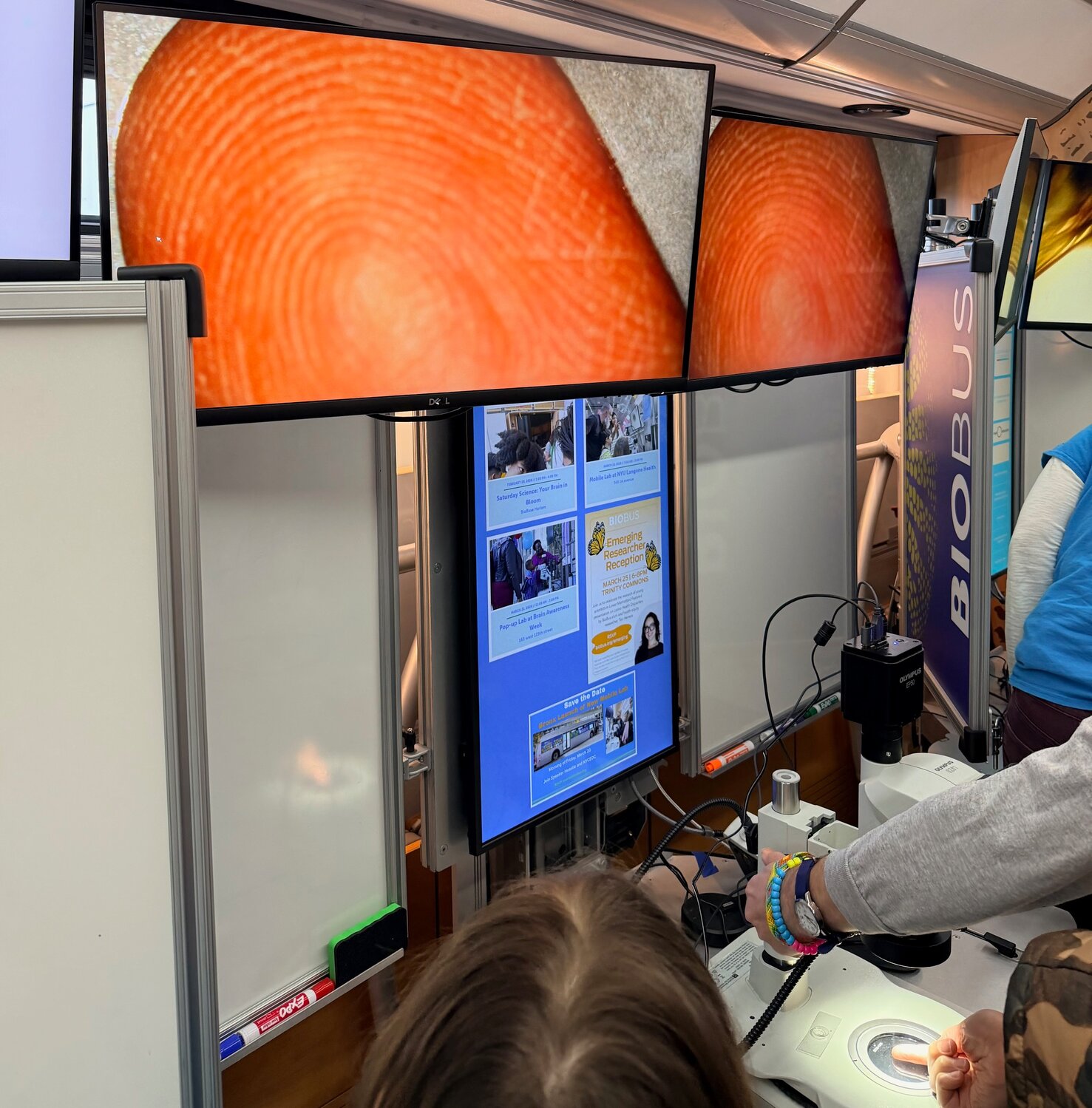


Children climbed aboard a new, all-electric mobile laboratory — dubbed the BioBus — at the Long Island Children’s Museum in Uniondale, peering into high-powered microscopes and examining samples of insects and organic matter during a hands-on demonstration.
The museum held a ribbon-cutting ceremony on Feb. 16 for the mobile science lab, which travels to schools across Long Island, New York City and Boston, and will now make several stops at the museum each year for special events. The expansion is supported by a $600,000 investment from the National Grid Foundation over the next three years.
During the ceremony, about 40 children helped cut the ribbon, and then crowded inside the mobile lab, taking turns looking through microscopes and asking scientists questions, as parents tagged along.
The BioBus’s interior was separated into two stations — one was “focus” and the other “hands on.” Children leaned over microscopes, adjusting the focus as magnified images of cells, tiny organisms and worms came into view. Ben Dubin-Thaler, a scientist and a BioBus co-founder, explained to them what they were examining.
“My favorite one was the bee,” 7-year-old Eoien Callan said. “It was actually so cool because you can see the pollen on it, and I never gotten to really do it before.”
The bugs were chosen for inspection based on what they thought would look good under the microscope, Co-founder Latasha Wright said with a laugh.
Sisters Rae, 2, and Ami, 5, accompanied by their mom, Freeport resident Lennaxia Brathwaite, found the worm station fascinating, looking at the insects under a microscope with a bright light and watching them in their environment, moving in dirt.
Brathwaite expressed appreciation for the experience, noting that such opportunities weren’t available to her growing up.
“This is awesome — I always loved science,” Brathwaite said. “I want them to experience it, to be able to be tangible and to touch things, to explore anything hands-on.
“The visuals and the tangibles, they’re going to have a lasting impression [from] this. She’s going to remember this,” she added of Rae, who stayed by the earthworm station most of the visit.
Brathwaite explained that her daughters have read books about worms from Raz-Kids, a website where they could choose what they want to read, and the trip to the BioBus made the literary experience come to life for her kids.
Built on a strong partnership between the Long Island Children’s Museum and National Grid, the BioBus is set to return throughout the year. Organizers expressed hope that the hands-on experience will continue sparking curiosity — and perhaps inspire the next generation of scientists.
National Grid’s partnership with the museum goes back more than three decades, when community members and spouses Roni Kohen-Lemle and Robert Lemle established the museum. The partnership later expanded with the support of Bob Catell, 89, former chief executive of KeySpan, who attended the ceremony, and through development efforts led by Edward Smits of Nassau Heritage.
“In 2010, that partnership deepened with the STEM initiatives,” Erika Floresca, the museum’s president, said at the Feb. 16 ceremony. “National Grid became the initial sponsor of Westbury Schools’ partnership, a green team environmental leadership program and our annual STEM weekend.”
Floresca said the continued support allows the museum to expand programming for students K-12, including special education services and bilingual instruction to ensure broader access.
“We know, and National Grid understands, if you spark curiosity early, if you nurture children’s confidence in asking questions, solving problems and testing ideas, you open opportunities,” she said. “Waiting until high school, if often too late, early engagement matters – National Grid gets this.”
Robert Simmons, head of the National Grid Foundation, addressed the attendees and invited Matthew Aromero, 7, and his brother, Jayden, 8, of Glen Cove, to the podium to share their excitement about the BioBus.
“I’m always ready,” Matthew said, eager to begin exploring.


